572M in. $225M out. Ouch.
Late last week Fox Factory closed the sale of Marucci, its baseball and softball brand, to a group led by Marucci co-founder and former big-league pitcher Kurt Ainsworth. Plenty of people saw this coming going into 2026, me included.
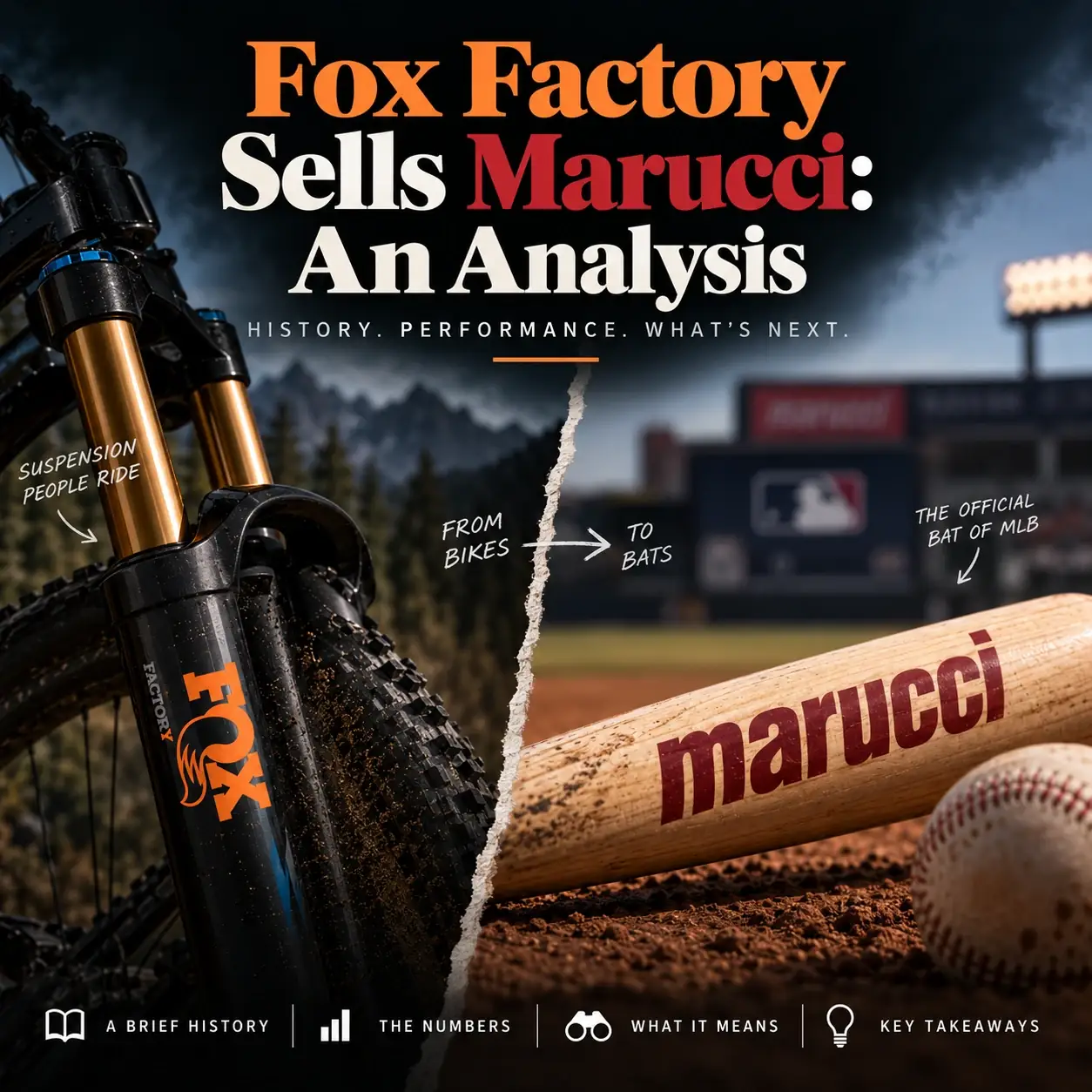
Time is short (I’m getting married this week!), but I wanted to carve out an hour for a quick look at what happened and what it means for a company that’s now back to bikes and trucks.
Below you’ll find some history, the question everyone keeps asking (why baseball?!), how Marucci actually performed inside Fox, and what the sale means going forward. Then I’ll put on my Monday morning quarterback hat and pull out some lessons for those of us who like to cosplay as CEOs and CFOs.
A quick note on AI: the ideas and opinions here are mine. Research was done with GPT Astra 6 and Opus 5.5, and Opus 5.5 helped edit. There’s no way I get this out in a week like this without some help from the robots. If you have thoughts on that approach, my email is in the footer!
A short history of bats, bikes and one private equity firm
Baseball and bikes have strangely been tangled together for decades before Fox ever bought a bat company. In a way, this always seemed normal to me, being I grew up a baseball player and (in my teens) a mountain bike racer. Aluminum, carbon, grips, and a private equity firm that seems to keep its toes in these waters. To tell this story we’re going to go way beyond Marucci, though…
Easton: the original bike-and-bat company
Any millenial like me who grew up in the 90s probably has fond memories of Easton. They were kind of the aluminum bat company, but also had a very strong relationship with the cycling industry. Lets get into it…
1922 to 1953: Doug Easton builds archery gear in California; Jas. D. Easton, Inc. is incorporated in 1953.
1969: Easton starts making aluminum baseball bats. Aluminum tubing becomes the company’s whole identity: ski poles, tent poles, tennis frames, hockey sticks.
Later: Easton brings the same tubing into cycling. Bike frame tubes, then bars, stems, seatposts and wheels.
2006: Fenway Partners buys Easton Sports for $400M and merges it with Riddell and Bell into Easton-Bell Sports. Bats, helmets and bike parts under one roof.
2014: Easton-Bell breaks itself up:
2016 to 2020: Bauer’s parent goes bankrupt in 2016. Easton Diamond Sports ends up with Rawlings in 2020.
So by 2015, Fox owned the Easton name in cycling while the Easton bat was a Marucci competitor.
Lizard Skins: the bike brand that learned to grip a bat
Next in this story is Lizard Skins, a brand many bike riders remember from back in the day as being the kind-of-weird company that offered stanchion covers, chainstay protection, grips, and other grippy neoprene type things for your bike.
1993: Brian Fruit founds Lizard Skins in Utah to make chainstay protectors and other bike protection. Grips and bar tape follow; pro road teams use the tape.
2010s: Lizard Skins takes its grip tech to baseball (DSP bat grip) and hockey, and becomes the Official Bat Grip of MLB.
October 2021: Marucci buys Lizard Skins. Terms were not disclosed.
Marucci: from a backyard shed to the official bat of MLB
Early 2000s: Jack Marucci, LSU’s head athletic trainer, starts making bats in his backyard shed because he can’t find a good wood bat for his son.
Mid to late 2000s: Former big-league pitcher Kurt Ainsworth and former big-leaguer Joe Lawrence join. The company grows into Marucci Sports in Baton Rouge (sources give different founding dates).
2006 to 2016: Marucci’s share of MLB players goes from about 4% to about 40%. David Ortiz, Albert Pujols and Bryce Harper swing them. Worth noting, Marucci really only aimed up market. They did not aim at tee-ball or youth (really) at this time.
2017: Marucci buys its main wood-bat rival, Victus.
April 2020: Compass Diversified (CODI) buys Marucci for about $200M, at the bottom of the pandemic.
2021 and 2023: CODI’s Marucci adds Lizard Skins and Baum Bat.
November 2023: CODI sells Marucci to Fox Factory for $572M and books a gain of about $241M.
January 2025: Marucci and Victus become the Official Bats of MLB.
September 2026: Fox sells Marucci to a group led by Ainsworth for $225M.
Fox Factory: every deal since the IPO
Pay attention to who the PE firm is here…
2008: CODI buys Fox for $80M. (yes, the same CODI)
August 2013: Fox IPOs at $15. CODI sells down through 2017 for about $527M, a 6.6x return.
2014: Sport Truck USA (BDS Suspension, Zone Offroad). Race Face and Easton Cycling, $30.2M.
2015: Marzocchi’s mountain bike line, bought from Tenneco.
2017: 80% of Tuscany (truck upfitting); the last 20% for $25M in 2020.
2019: Ridetech, about $14M.
March 2020: SCA Performance (upfitted trucks), $329.5M. Fox borrows, then raises $198M of stock at $76.
2021: Outside Van and Shock Therapy.
March 2023: Custom Wheel House (Method Race Wheels), $131M.
November 2023: Marucci, $572M, all on new debt.
December 2024: Marzocchi motorcycle suspension, $20.5M.
February 2026: Sells its Phoenix aftermarket shops (Shock Therapy, Upfit UTV, Geiser) at a $10.6M loss.
September 2026: Sells Marucci for $225M.
Where the threads cross
Same seller, twice. CODI owned Fox from 2008 and sold its last shares in 2017, then sold Marucci to Fox in 2023. Fox bought a bat company from its own former parent.
A bike brand came along for the ride. Buying Marucci put Lizard Skins, a Utah cycling-grip brand, inside the same company as Race Face’s grips.
Easton on both sides. Fox has owned Easton’s cycling business since 2014. Easton’s bat business, a direct Marucci rival, now sits at Rawlings.
A home was already built. By 2023 Fox had renamed its bike unit the “Specialty Sports Group,” a label broad enough to hold bats.
Why baseball?
This is the $400M of a loss question. Why did a company who specializes in suspension, something basically as far removed from baseball as possible, decide to buy a ball sport company?
Short answer: We don’t really know, but I do know Fox had a clean balance sheet, and Marucci maybe looked like Fox’s own playbook in a different sport. With that comes a different demographic, a different supply chain, a different sales channel but a similar “type” of business (I guess?).
What management said
On the Q3 2023 call Mike Dennison made four arguments:
Same playbook. Win the pro athlete, then sell to the enthusiast. “It’s literally Fox with a different name.” Marucci and Victus were on “more than 56%” of MLB hitters’ wood bats.
Better numbers than Fox. Marucci was growing faster and running an EBITDA margin in the mid to high 20s, above Fox’s own 19% to 20%. It would be accretive from day one.
Diversification. Fox had too much OEM exposure. Bats are an aftermarket, enthusiast purchase, and management pitched the business as “acyclical.”
Synergies. (there is that word!) CFO Dennis Schemm pointed to “metallurgy, manufacturing and supply chain.” Fox knows aluminum and composites, and so do alloy and composite bats.
What was going on underneath
The bike business had just fallen apart. In Q3 2023, Specialty Sports sales fell 58%, from $173.9M to $72M. The same release that announced Marucci cut full-year sales guidance by about $240M.
There was a target to hit. Fox reaffirmed its “2025 vision” of $2B in sales at a 25% adjusted EBITDA margin that same day. The company said the target excluded Marucci. Even so, a fast-growing, high-margin bat company looked more on-strategy than anything in bikes that quarter.
Borrowing was easy. Leverage was about 0.5x. The bank group offered $600M of term debt priced at just 50 basis points over the revolver.
Fox knew the seller. CODI had owned Fox, installed its professional management team, and made 6.6x on it. Buying a business from a sponsor you know well lowers the diligence burden, or feels like it does.
Fox had become a brand holding company. Trucks, wheels, vans, UTV upfits: most of the past decade’s deals had little to do with suspension engineering, but I’d argue there was a very obvious tie through the rest of it. I think the argument here (from management) is the common thread was enthusiast brands with pro credibility.
Who pushed back at the time
The sell side saw the problem right away. CJS’s Larry Solow: “on the surface, the acquisition makes little sense.” Stifel’s Jim Duffy said Marucci “complicates the equity story” and “limits balance sheet flexibility.” B. Riley called it “a surprising offshoot” that “doesn’t seemingly benefit from FOXF’s legacy core competency.” The stock fell 27% the next day (SGB Media).
My take: We will get into this more below, but it was obviously a strange acquisition. I’ll borrow from the Buffet/Mungerism world here with the old quip, “show me the incentive and I’ll show you the outcome”. Management does have incentive to take a swing for the fences (pun intended) and if they come up short (which this clearly did) they often get more at bats. Looking back, annual bonuses at fox were tied to adjusted EBITDA and stock grants after the deal pay out for both rev growth and EBTIDA margin. Both could rise (or at least be insulated) when you buy a business, and neither counts the interest on the debt used to buy it. I think this really explains the whole thing. Its justifiable to the board, and its plausible to make things “look better”, with no incentive to not do it.
How Marucci did inside Fox
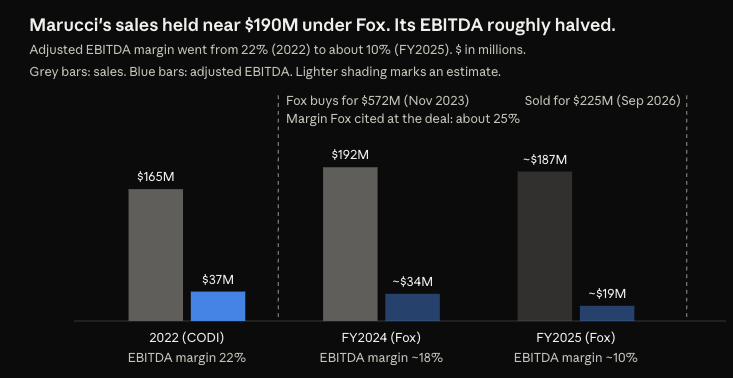
Sales held flat and the brand got stronger, but profit fell by more than half. Marucci came in near a 25% EBITDA margin and left around 10%, while Fox’s bike business next to it held its margin through the worst bike downturn in decades.
Fox never broke Marucci out as its own segment. It sat inside the Specialty Sports Group (SSG) with Fox bike, Marzocchi, Race Face, Easton, Ride Concepts and Lizard Skins. The Marucci-only numbers below come from filings where Fox disclosed them; the rest are estimates, labeled as such.
Against the rest of Fox
SSG margin went down while bike margin held. SSG adjusted EBITDA fell from $117.8M (23.1% of sales) in FY2024 to $107.6M (21.1%) in FY2025, even though Fox said bike sales rose in 2025. Backing out my Marucci estimates, the bike business ran around 26% to 27% both years. Most of the SSG decline looks like bats.
Fox overall: adjusted EBITDA margin was 12.0% in FY2024 and 11.5% in FY2025. Marucci went from well above the company average to below it.
Softball was the bright spot. Management said softball grew about 500% since 2024. It wasn’t big enough to offset softer bat volumes.
What went wrong operationally
Spending ahead of MLB. Fox added bat manufacturing capacity and marketing spend ahead of the January 2025 official-bat deal, which squeezed margin in late 2024.
Channel changes and destocking. Marucci pushed further into big-box retail right as Dick’s and Academy cut inventory. Fox blamed “OEMs, distributors and retail partners” managing toward “leaner inventories.”
Tariffs. Imported bats and equipment were hit in 2025. Fox’s net tariff cost across the company was about $25M that year.
Delayed launches. The 2026 bat launch slipped a quarter, in the business’s most important selling season.
What went right
The brand held up. On opening day 2026, Victus had 27.8% and Marucci 16.7% of MLB bats (The Advocate). Together they’re still the pros’ bat.
The MLB deal happened on Fox’s watch. Marucci and Victus became the Official Bats of MLB in 2025, which Ainsworth credits to Fox’s ownership.
Sales didn’t fall apart. Revenue stayed near $190M a year. The problem was entirely the margin.
Caveat for the post: Fox never published Marucci’s standalone EBITDA. The 10% figure is Stifel’s estimate; the FY2024 margin and FY2025 sales are my own estimates from Fox’s disclosures.
The divestiture (last week)
On September 25, 2026, Fox sold Marucci for $225M, 39 cents on the dollar, and put every dollar of cash toward the debt that paid for it (Fox release).
The terms
Price: $225M enterprise value. $200M in cash at closing, plus a $25M unsecured, subordinated, convertible note due December 31, 2026. If the note isn’t paid, Fox can convert it into equity in the buyer’s parent.
Buyer: Squared Up Holdings, a group led by founder and CEO Kurt Ainsworth, backed by current and former MLB players (Marucci release). Victus, Lizard Skins, Baum and The Stable all go with it. HQ stays in Baton Rouge.
Process: A strategic review announced in February 2026. More than 80 potential buyers contacted, 15 indications of interest. Marucci managers in the buyer group were walled off from evaluating bids.
What it does for Fo
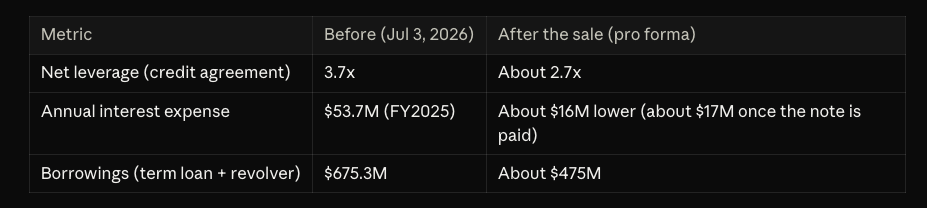
Fox also pays about $7.5M in transaction costs from cash on hand. The accounting loss on the sale shows up in the Q3 FY2026 10-Q, due around early November.
Reading the price
The multiple didn’t move; the earnings did. $225M is about 11x the roughly $20M of EBITDA Marucci now makes. That’s about the same multiple Fox paid in 2023. The business simply earns less than half what it did.
It came in low. Stifel had modeled a sale near $300M, a figure I was hopeful for back in Q1.
The note is a tell. When 11% of the price is an unsecured IOU, the buyer couldn’t raise the full amount in cash.
Insiders bought. The people who know Marucci best, its founder and the players who swing its bats, chose to buy it at this price. That says they believe the margin can come back once it’s out of Fox.
Dennison’s summary: Marucci “did not deliver the returns we expected inside Fox.”
Post-mortem
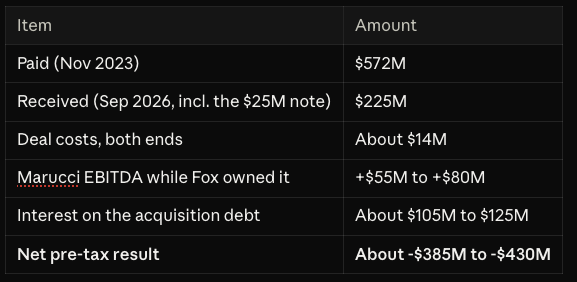
The asset was good and the price was roughly market. What sank the deal was the financing, the timing, and a margin collapse Fox had no special skill to fix. All in, I estimate the round trip cost Fox about $385M to $430M pre-tax. That’s roughly half of what the whole company is worth today.
The scorecard (my estimates)
What Fox got right
It bought a real brand and didn’t break it (it is still worth something). Marucci and Victus are still on more pro bats than anyone, and the MLB official-bat deal happened under Fox.
It didn’t hold on out of pride. Fox announced the review, ran a real process (80+ buyers), walled off insiders, and sold within about seven months.
Every dollar went to debt. Leverage drops about a full turn, and the covenant has room again. Leverage has been something I’ve been keenly focused on. This is a good thing from a debt perspective…but then again, this is also a bit like saying “we got out of jail, with a hefty legal bill” (after putting yourself there).
It said it plainly. “Did not deliver the returns we expected” is about as direct as a public-company CEO gets.
It never did the leveraged buyback. The $300M authorization announced with the deal mostly went unused. Borrowing to buy stock at $60 would have lost even more than Marucci did.
What Fox got wrong
Floating-rate debt at the top of the cycle. $600M of floating-rate term debt, taken on with SOFR near 5.3%. At an 11x purchase price, Marucci’s EBITDA yield (about 9%) barely beat the cost of the debt (about 7%). No margin for error.
Bought the peak from a pro. CODI bought at the 2020 bottom and sold at peak margins. Marucci’s 25%+ margin was a high point, and growth had already slowed from 40% to about 18%.
No edge in the business. There were no shared customers, channels or plants. Once growth stalled, Fox had no operating lever of its own to pull. “Metallurgy synergies” never showed up anywhere. (Please, offer what this is if you know)
Some of the margin damage was self-inflicted. Spending ahead of MLB, a bigger push into big-box retail, and a delayed bat launch all happened inside Fox. The category grew; Marucci’s profits didn’t.
Bad timing on its own business. Fox levered up the same day it cut guidance for a bike business in freefall, into a future that was anything but certain. The core was supposed to carry the debt, and it couldn’t. To me this is the huge error. Going into a non-core asset as your core asset is tanking is crazy-pill type of stuff.
Too many messages at once. A guidance cut, a record deal, a buyback and a $2B/25% target all landed on one day. The market read it as confusion, and the stock fell 27%.
The lessons
Nine takeaways I had from this deal going awry.
Know what you’ll do better than the last owner. I’d bet Fox couldn’t name one thing it would do for a bat company that CODI wasn’t already doing.
Don’t borrow to diversify. Shareholders can diversify for free by buying another stock. Going “non-core” only makes things more complicated for shareholders, and the debt burden muddies the balance sheet.
When a professional seller is selling, ask “why now?” CODI bought Marucci in the 2020 panic and sold it shortly thereafter for a sizable gain. When there is a wolf on the other end of a deal, you might be the proverbial sheep.
Underwrite the normal year, not the best year. A 25%+ margin at a consumer brand is a high-water mark. Price the deal on what it earns in an ordinary year, or a X year rolling average.
If the math only works when everything goes right, it doesn’t work. A ~9% EBITDA yield against ~7% debt leaves two points of cushion. One bad year eats that. The juice aint worth the squeeze.
Match the debt to the asset. Floating-rate debt against a business that sells discretionary goods is two bets stacked on top of each other: rates and the consumer. That feels as predicatble as a bull ride at the rodeo.
Fix your own house first. Fox cut its guidance the same day it bought Marucci. When the core business is in trouble, the balance sheet is its life raft. Don’t spend it on a boat for someone else.
When you know, sell. Fox did this part right.
“Why baseball” is worth asking. A better one might be “why this, with borrowed money, right now?”
What’s next
Management has earned a second chance at running the business. It hasn’t earned a second chance at buying one.
The company: Leverage falls to about 2.7x, the core business is back in focus, and more small sales are likely. At around 7x EBITDA excluding Marucci (my estimate), Fox is starting to look cheap enough for someone with a checkbook to notice.
Management: The same CEO and CFO bought Marucci and sold it. The board kept them, tied their pay back to returns, and put them on a cost program. The way back is boring: hit the Q4 margin, set a leverage target and meet it, and do no deals for a while.
Full circle
Marucci goes back to its founder, at 39 cents on the dollar.
Lizard Skins, the bike-grip brand, leaves with the bats. Fox keeps Race Face and Easton.
CODI won both trips: 6.6x on Fox, then a gain of about $241M selling Marucci to Fox.
Fox’s debt went from $200M at the end of 2022 to about $475M today.
Conclusion
Fox paid $572M, got $225M back, and after interest and deal costs lost roughly $400M (my estimate). That’s about half of Fox’s $780M market value, or $9 to $10 of the $18.55 share price. Marucci isn’t a bad brand or a bad company, but this is a textbook lesson on remembering what “makes your beer taste better”. IE, don’t get sidetracked on stuff that isn’t core to your company doing what it does better than literally any other company on the planet.
In the end, Fox bought a bat company from its old owner and sold it back to the guy who built it. The only thing that changed hands for good was Fox’s balance sheet.
About me: I spent 15+ years in finance and tech: covering markets at StreetAccount/FactSet, serving as CPO at a venture-backed fintech, and holding CFO, COO and CTO seats along the way. Today I run GuideRail, a firm that builds software you actually like to use within your business, all with improving business outcomes financially front and center. I live in Victor, Idaho, and was previously the co-host the B.S. Podcast on Vital MTB.
Work with me: Sick of rigid software that costs too much and comes with cute-but-not-impactful AI features? Reach out. I build tools that fit how your business actually runs, and I bring a CFO’s eye to whether they pay off. jeff.brines@gmail.com or jb@guiderail.io.
Disclaimer: This is analysis and opinion, not investment advice. I have no position in FOXF at the time of writing. Do your own research.
If you enjoyed this, subscribe and share. It’s the best way to support what I’m building here.
Just for fun
As a ball player growing up, I LOVE watching the Baseball Bat Bros. Marucci often a center piece of any test. Its interesting stuff, and makes me want to go to a batting cage.
The Baseball Bat Bros channel, which reviews a lot of Marucci bats
Sources
Fox Factory: Q3 FY2023 release and Marucci agreement, Q3 FY2023 call, FY2023 10-K, FY2025 10-K, Q4 FY2025 release, Marucci sale release, Ridetech 8-K, SCA 10-Q
Compass Diversified: Fox case study, final Fox share sale, 2017, Lizard Skins acquisition
Marucci: return to founder-led ownership, The Advocate on the sale, Wikipedia history
Easton and Race Face: Easton Sports history, Easton baseball to Bauer, Fox buys Race Face and Easton Cycling, Rawlings buys Easton Diamond
Trade press: SGB Media on analyst doubts, Pinkbike on the deal, Bicycle Retailer, Q4 FY2025 SSG, SGB Media, Q4 FY2025 diamond sports