Note from Jeff: This is a long post. I highly encourage you to scroll down to the wide angle “13 year” look at the company if the Q2 analysis is boring. This really should have been two posts, but I like the idea of swapping from a zoom lens to a wide angle lens in the same piece. Plus, at this point, I don’t think I need to tell anyone from my audience to “skip ahead if I get long winded”. LOL.
If you asked people to name the best publicly traded company in the bike industry over the last decade, I don’t think it’s crazy to guess most would say Fox Factory (FOXF). They have everything you look for in an at-scale enterprise: premium brand, deep OEM relationships, aftermarket pricing power, operational discipline, great engineers, and a storied name.
So it might surprise you that $10,000 put into the S&P 500 the week Fox went public in August 2013 is worth roughly $56,000 today. The same ten grand into Fox? About $12,600. Heck, risk free T-bills basically matched it.

In that same thirteen year time horizon, Fox grew revenue more than five-fold and expanded into a number of different verticals. The business did awesome while the stock is currently a dud.
Instead of the normal quarterly analysis some might be expecting here, we’re going to look at Fox through two different lenses. First the zoom lens: the quarter Fox just reported, up close. Then we swap to the wide angle, squint at what we see, smash all this together and try to understand what the tea leaves are telling us.
With all that said, lets get into this one!
Housekeeping: no position in FOXF, none of this is investment advice, and I’m always reachable at jeff.brines@gmail.com
The Zoom Lens: The Quarter
The good news
Fox did $358.1 million of revenue, the high end of what they told us to expect, and $45.5 million of adjusted EBITDA, about $5 million above the high end of guidance. Even after you strip out the roughly $2 million of tariff refunds that fell out of the sky this quarter, it’s a clean beat.
Finance pit stop (I’m going to do this throughout this piece so I don’t talk past anyone. Skip ahead if you know this): EBITDA is earnings before interest, taxes, depreciation, and amortization. In plain English: roughly the cash the machine throws off before you pay the bankers and the taxman, and before accounting spreads the cost of the factories over the years. EBITDA margin is that number as a percentage of sales, and it’s the fastest way to answer the question “is this a good business, or just a big one?”. Finance types usually love it…except for Warren Buffet/Charlie Munger (and for good reason, but that’s a whole other substack)
One of the big attention grabbers on the KPI side was EBITDA margin. Fox went from 9.7% adjusted EBITDA margin in Q1 to 12.2% in Q2 once you exclude the refund. That’s 250 basis points (basis point = 0.01%) of clean sequential improvement in thirteen weeks, which for a manufacturer is like taking 25 seconds off your race run between practice and finals.
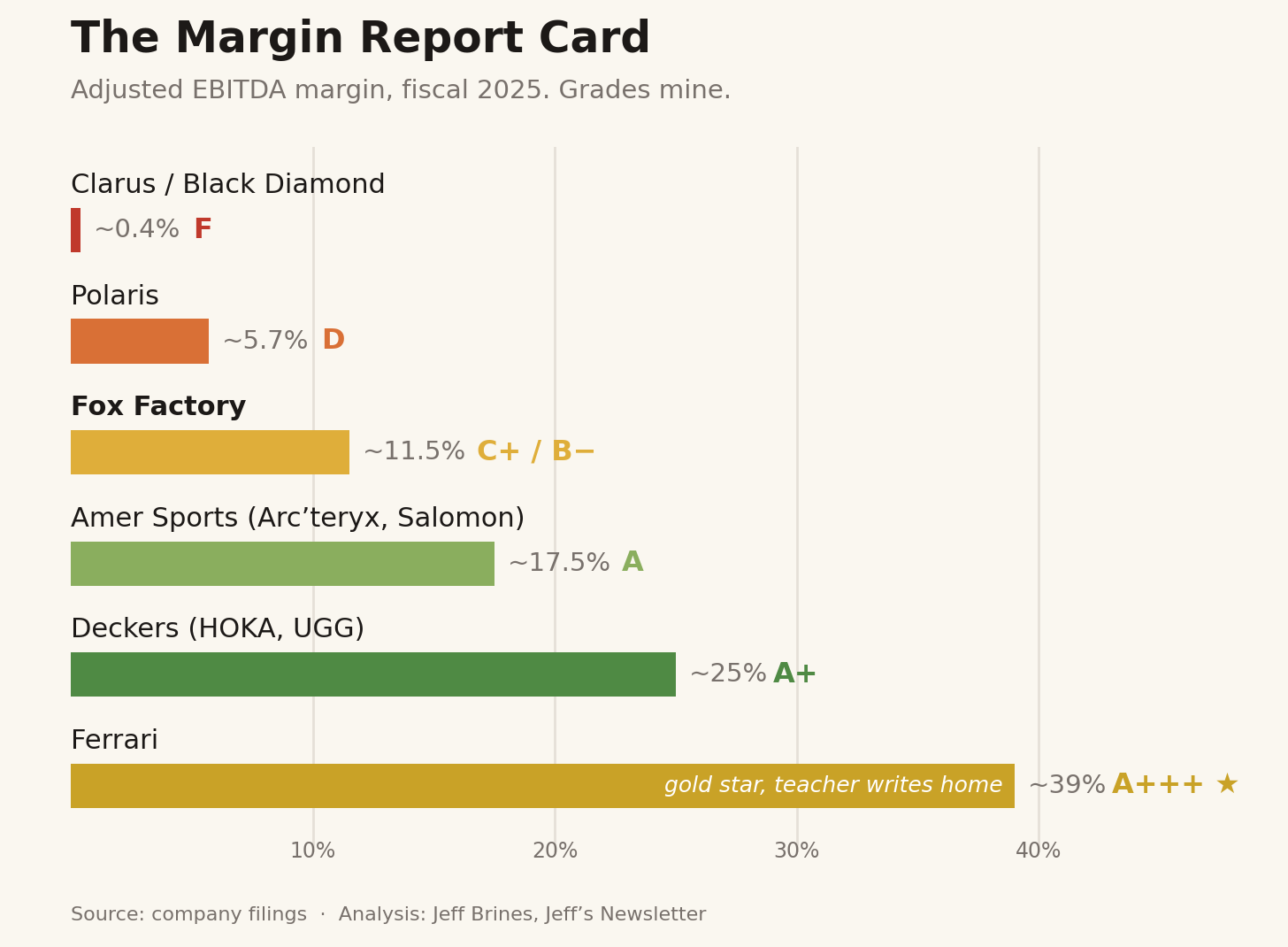
For context on what margins mean in this world, my running report card (all fiscal 2025 numbers, grades mine):
The rest of the quarter rhymes with the margin story. GAAP earnings swung from a loss in Q1 to a small profit. Free cash flow inflected: Q2 threw off roughly $25 million on its own, effectively filling the hole Q1 dug. Inventory days dropped from about 150 to 136, total debt fell $20.5 million, and, this is the detail I care about most, R&D went up while G&A and sales and marketing went down.
Worth noting, there’s a lazy version of “cost optimization” where a mature company starves product development to make the numbers look better in the near term. Fox is doing the opposite: trimming organizational fat while feeding the engineers. I’d like to see a lot more of this sort of reinvestment on behalf of the brand in the future. (remind me to write “what I’d do if I was CEO of Fox” at some point as a fun thought experiment)
So it’s all roses? Not quite. Lets unpack them…
Thing one: the raise that wasn’t
Fox raised full-year revenue guidance from $1.33 to 1.42 billion up to $1.42 to 1.47 billion. The headlines said “raise.” but we need to watch what happens to profit: the adjusted EBITDA guide went from $174 to 203 million to $176 to 196 million.
Finance pit stop: when a company gives you a guidance range, the midpoint is the actual plan and the ends are the scenario doors. Always do the midpoint math yourself, while taking into account what happened with the range (got bigger or smaller). That’s really all there is to it.
Do the math here and you get roughly $73 million more revenue than the plan from three months ago, and slightly less EBITDA. The implied full-year margin fell from a range of 13.1-14.3% down to about 12.4-13.3%. A full point of margin, quietly surrendered inside a “raise.”
The culprit is a number that didn’t exist in May’s guide: roughly $20 million of input cost inflation above the original plan, about $15 million of it landing in the back half. Steel, aluminum, fuel, ocean and inland freight, carrier surcharges, expedite and rerouting costs, all pushed higher by the same geopolitical mess driving everything else this summer. Notice the shape-shifting: in May the story was tariff relief whereas ninety days later a $20 million headwind is back wearing different clothes, having moved from the tariff line to the commodity and freight lines, and ironically driven by the same person (I’ll let you figure out who).
CFO Dennis Schemm said “persistence at current levels is our baseline rather than our downside case.” Translating this for normal non wall st types: they’re planning for the pain to stay, not praying for it to leave, which is the correct thing to do. That said, the practical result is that Fox grinds out $25 million-plus of hard-won savings and hands a big chunk of it straight back to the commodity complex and the shipping companies. Running this business right now is running faster on a treadmill that keeps speeding up.
Thing two: the entire year now lives in Q4
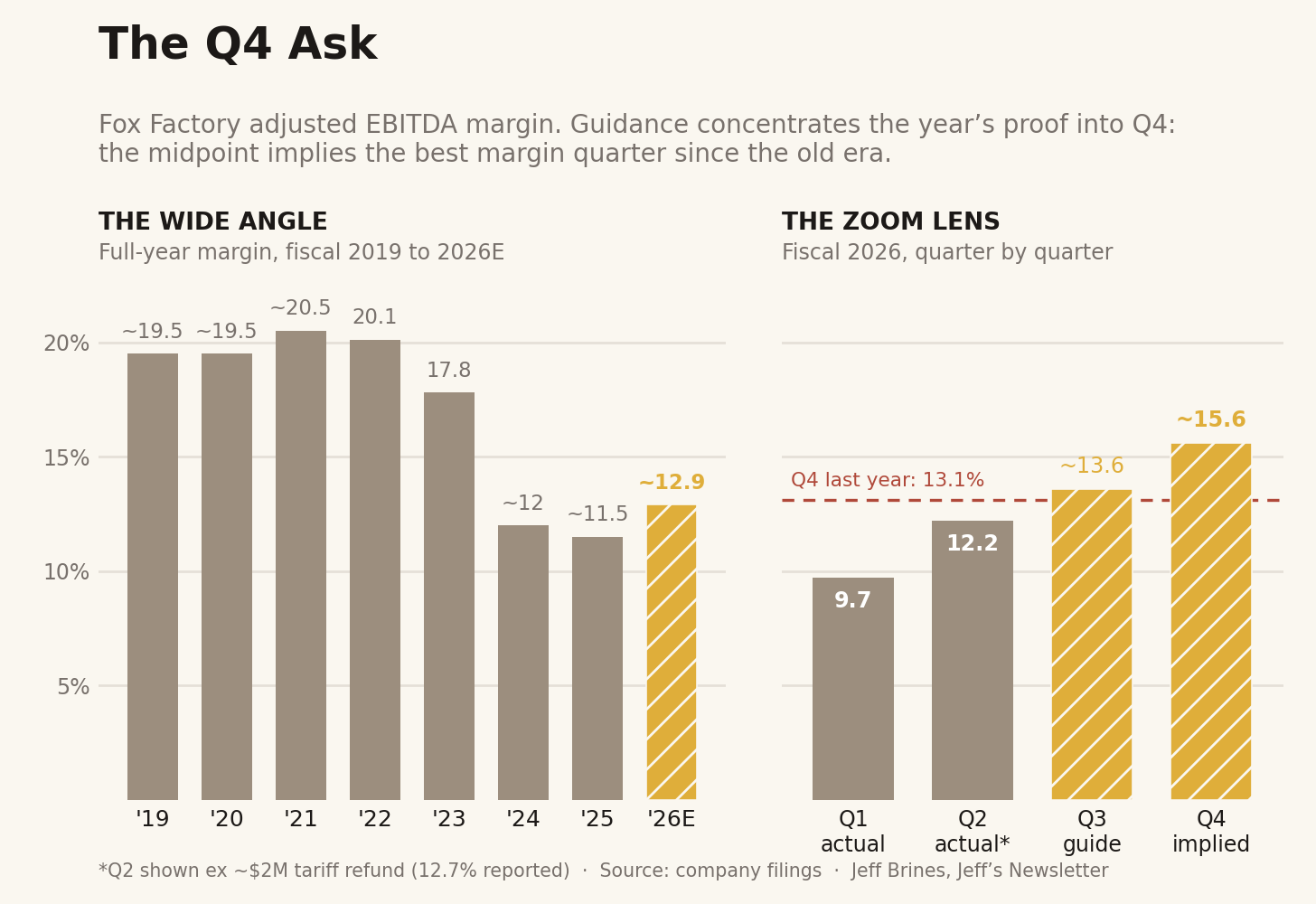
Take the full-year EBITDA guide, subtract the $81.2 million already booked in the first half, subtract the Q3 guide of $46 to 54 million. What’s left is what Q4 has to deliver. To their credit, when Stifel asked management to walk the bridge, the CFO walked us through it and the plan ends the year at roughly a 15.6% EBITDA margin in the fourth quarter. So, lets put 15.6% next to reality:
Quarter Adj. EBITDA margin Q1 2026 (actual) 9.7% Q2 2026 (actual, ex-refund) 12.2% Q3 2026 (guide, midpoint) ~13.6% Q4 2026 (implied, midpoint) ~15.6% Q4 2025 (actual, for reference) 13.1%
The midpoint of guidance requires the best margin quarter Fox has delivered in years, in arguably the worst input cost environment they’ve faced over that same stretch. Another way to size it: the back half of 2025 produced about $79 million of EBITDA. The midpoint here needs the back half of 2026 to produce roughly $105 million. What this means is its up 32% year over year on essentially flat revenue, all of it self-help.
The self-help bridge has some soft planks and roughly $25 million of remaining gross savings, minus the ~$15 million of fresh inflation, nets to about $10 million of true structural improvement. The rest leans on things that have to go right: the F-150 chassis supply actually returning in early-to-mid September (it already slipped once, courtesy of the fires at Novelis’s aluminum plant), the Marucci bat launch carrying through (already slipped from Q2 to Q3), maybe some other product tailwinds, favorable tariff comps, seasonal mix, and pricing recovery from OEM partners that, per the CFO, has barely started, since the $20 million is too fresh and those conversations begin later this half.
Any two of those slip and you land at the low end, which implies a Q4 margin below what they just printed. To be fair, they designed the year this way on purpose and have said so since February but my point still stands, everything rests on a banner Q4.
Thing three: the number that disappeared
Last quarter, management gave us a specific commitment: net leverage of 3.0x by year end. I put it on the watch list and said if they hit it the turnaround thesis is validated, miss it and the “big boat turning” framing I gave you last quarter is stalling.
This quarter, the target didn’t really come up. What we got instead: leverage at 3.7x against a 5.0x covenant (a covenant, I’ll note, they decided to amend upward from 4.5x in May), net debt down about $9 million year to date, and qualitative language about meaningful progress, but no 3.0x. Funny enough, none of the five analysts on the call asked where it went (though I have my ideas why).
Finance pit stop: leverage here (based on credit agreement) is net debt divided by trailing-twelve-month EBITDA, i.e., how many years of profit it would take to pay off the debt. The sneaky part is the “trailing twelve months.”
Leverage went from 3.74x to 3.7x this quarter, basically nothing, despite $20.5 million of debt paydown and a 27% sequential jump in EBITDA. Why? Because the first half of 2026 ($81.2 million of EBITDA) came in below the first half of 2025 ($88.9 million), so every strong new quarter is replacing a stronger old one in the trailing math. Simply, the denominator hasn’t turned yet.
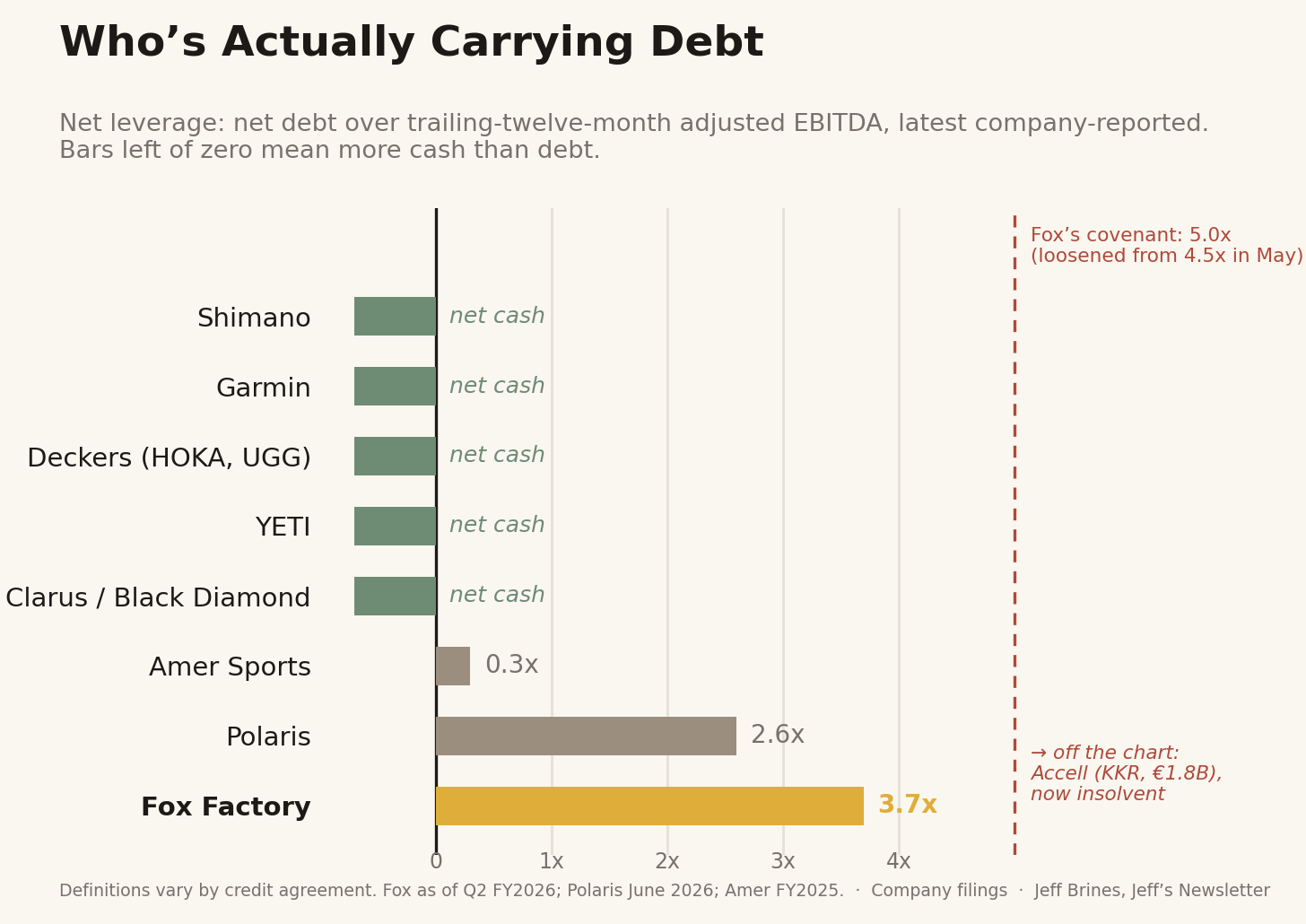
My hunch is 3.0x by year end was never really a debt paydown story but rather a story about Q4 EBITDA being big enough to flip the trailing number. The vanished leverage target and the 15.6% Q4 ask are the same fact wearing two different hats. I don’t think dropping the number is sinister or some slight of hand, but I think a CFO ran the same arithmetic I just did and doesn’t want to own a target he might miss by a quarter turn. All that said, put a pin in this because when we zoom out you’ll see why leverage is the single most important thing this company discloses.
One more note while we’re here: the release says any cash from further portfolio actions goes straight to debt reduction, and Fox continues to evaluate strategic alternatives for non-core assets. Translation: the leverage path may quietly assume an asset sale that isn’t in the guide.
Bikes + a Cryptic Amflow Message?
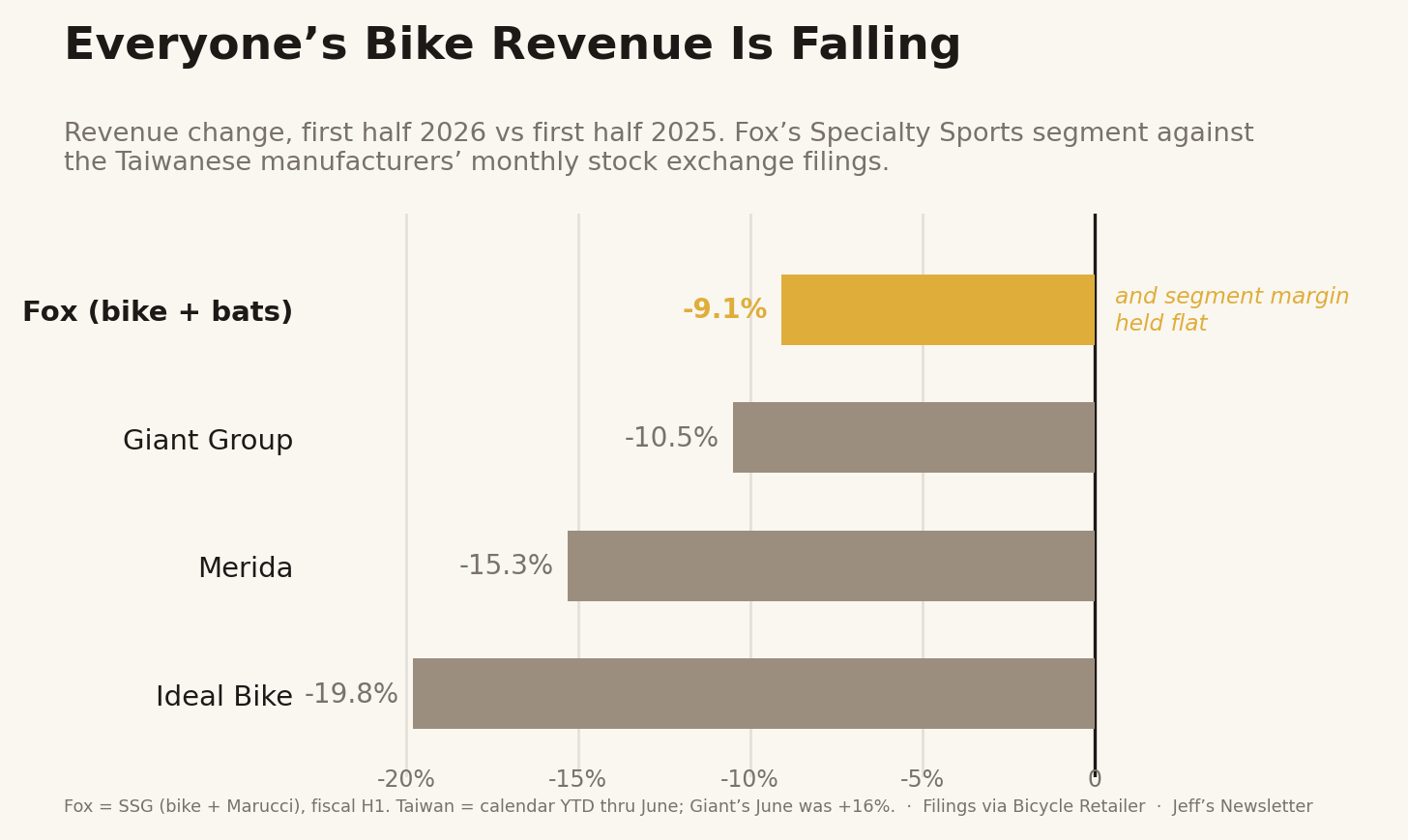
Buried in the segment detail is an interesting tell. SSG, the bike-and-bats segment, fell 9.4% year over year to $124.3 million (up 12.5% sequentially, for what it’s worth). Down 9% sounds bad until you look around this industry where you’d see “that aint bad!”. The impressive part is what didn’t move, too: segment margin held flat at roughly 22%, an A on the report card scale from earlier, on nine percent less revenue. Almost nobody else in the bike supply chain protected margin through this downturn like Fox Factory has (I said “almost” for a reason).
Don’t confuse resilience with recovery, though. Bike is guided flat for the full year, so if you were waiting on the great 2026 rebound, this call politely closed that door. As I’ve said before, we are in a “new normal”.
Moving on, listen to how management described demand; consumers are cautious overall, they said, yet pursuing new technologies and brands “aggressively.” Fox said it’s benefiting from its relationships with “new players” and the “disruptive technologies” they’re bringing to market, calling them a stabilizing force in a volatile market. And then CEO Mike Dennison, in Q&A, on the new e-bike product: it’s “sold out, which is something we haven’t seen in bike for quite some time.” (this might be the most important paragraph in this entire piece for us bike nerds)
Fox will not say the names, but its pretty obvious: DJI. Avinox. Amflow. This is basically the thesis I laid out in the Q2 industry roundup showing up in Fox’s own numbers: the economic value of the bicycle is physically relocating out of the frame-groupset-brand stack and into the motor-battery-software stack. The analog bike became a victim of its own success. A good bike from 2021 is still friggin good, and the industry wants $7,000 to sell you a marginally better (in some way?) version of it, while an e-bike with a new motor system fundamentally changes the sport; you can’t hang with dudes on a Class 3 28mph 2 hp beast if you are on an EP8 bike. Those are not equivalent upgrade propositions, especially when you consider what $6-7K buys you in e bikes right now.
Side note/disclaimer: One quarter of scarcity is a datapoint. Two is a trend. But when the arms dealer tells you which side is buying ammunition, believe them.
The robot nobody asked about
One last thing from the call that I really wish someone would have asked about. Buried in the prepared remarks the company noted a first-time award from an entirely new automotive OEM, putting Fox’s tech on an autonomous electric vehicle, shipping at the tail end of this year. Who is it?!
Fox is putting damping intelligence (live valve I assume) on a robot car platform. Five analysts asked questions during the Q&A and somehow adult slow-pitch softball got airtime but this got crickets. Maddening. I really wish someone pried a little to understand if this is real, or if its just a little prototype pilot style program from a self driving car company nobody has heard of. As an aside, think they’ll let me ask a question on the next quarter’s call? If anyone at Fox IR is reading this, let me know ;).
Anyway, that’s the quarter which is to say Fox is a genuinely improving company with a very large bill coming due in Q4. Now let’s swap lenses and see what the wide angle might reveal…
The Wide Angle: How a 5x Business Became a Flat Stock
Two eras, one ticker
Now we are going to take off the 70-200mm lens (zoom lens) and put on an 18mm (wide angle) to look at this business from a much broader perspective with respect to time.
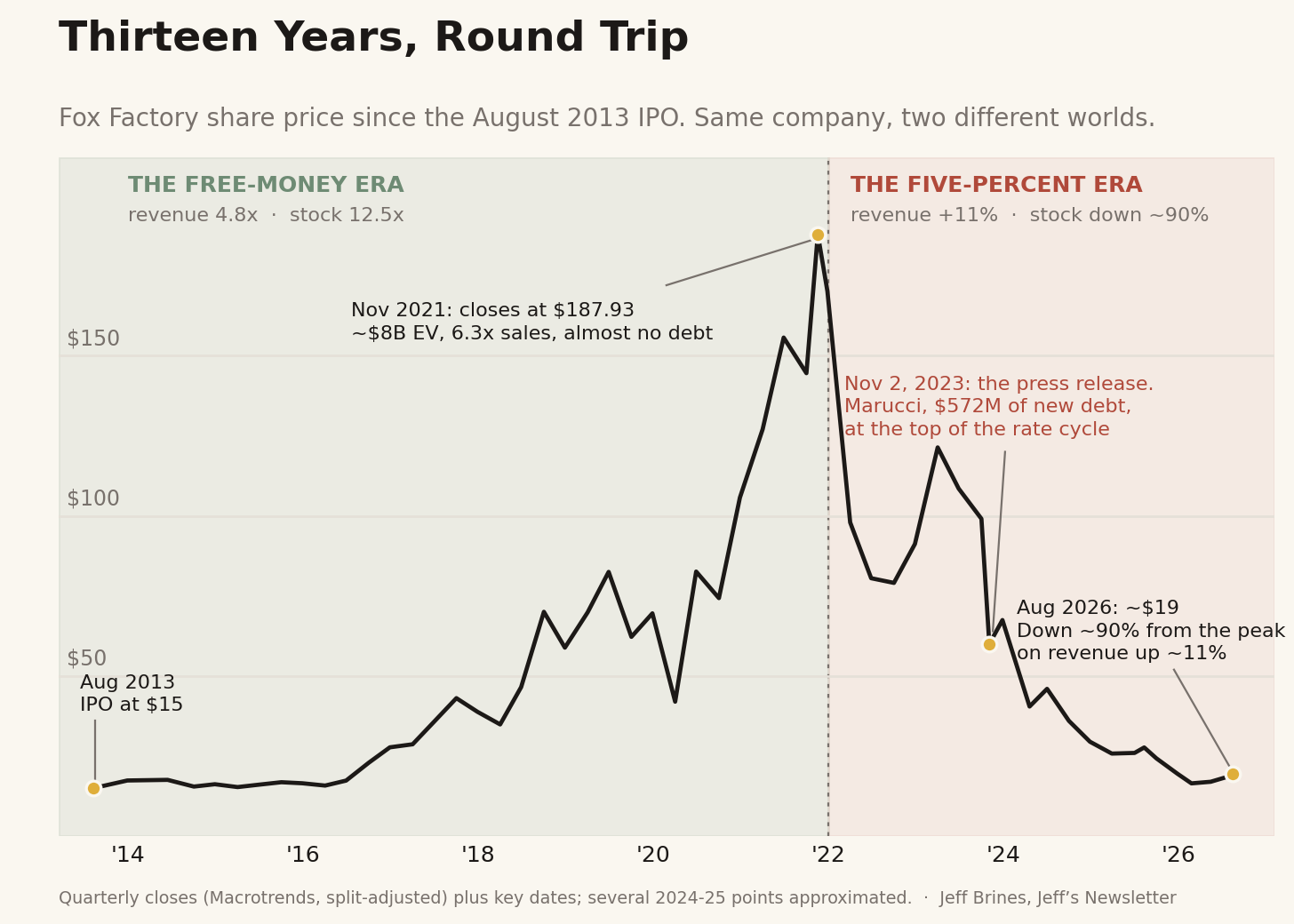
Fox IPO’d in August 2013 at $15 a share. It trades around $19 today. Below is a fun visual.
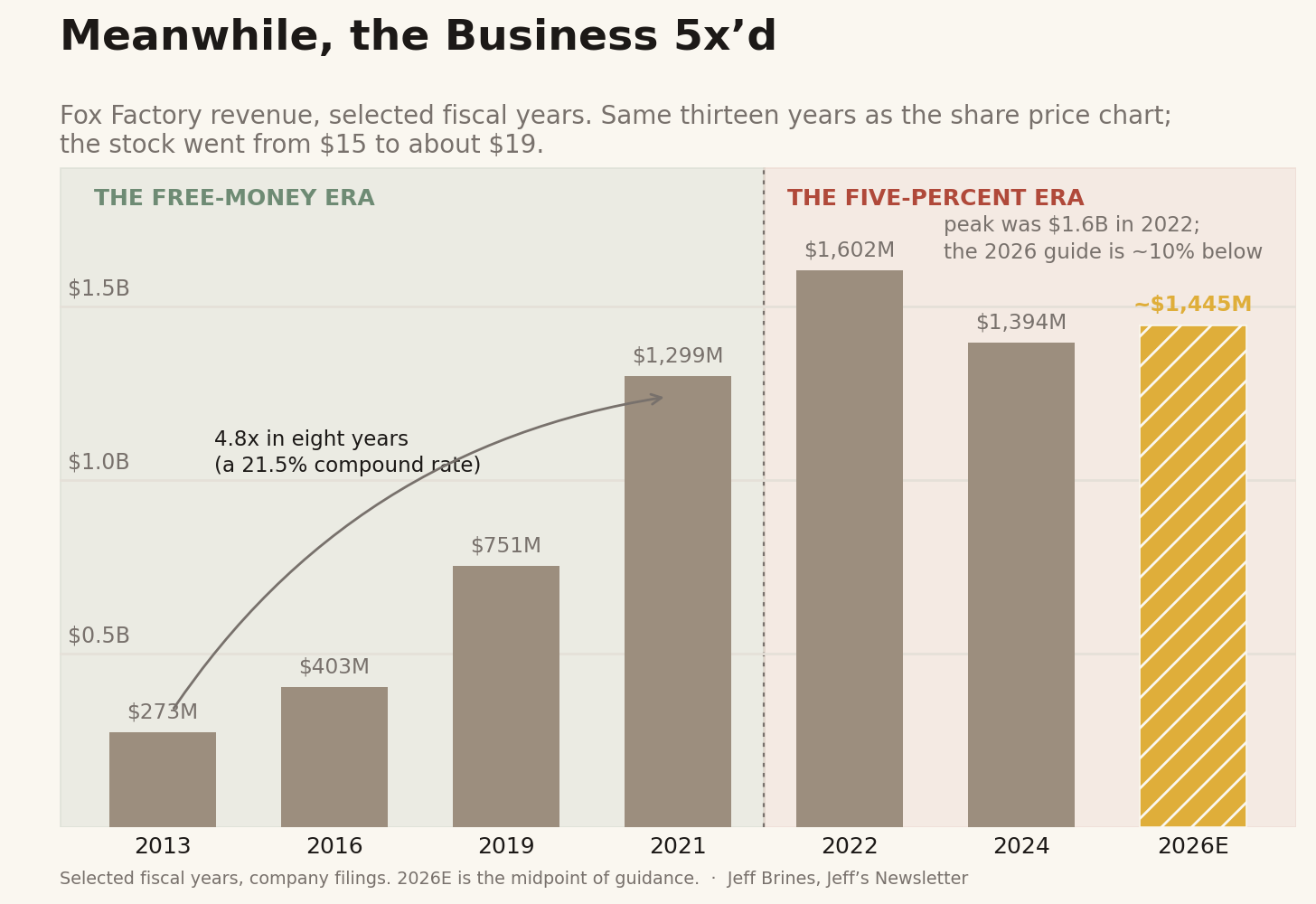
Meanwhile, the business did this on a revenue basis…
It really is a tale of two companies. Lets get into it.
Era one, 2013 to 2021: revenue grew 4.8x, a 21.5% compound rate for eight straight years, which for a hardware manufacturer is a genuinely elite operating record. The stock went from $15 to a closing high of $187.93 in November 2021. That’s 12.5x.
The business grew 4.8x, the equity grew 12.5x. How does that work? Well, in part equity expansion is driven by the discount rate you apply to future cashflows, and during this time discount rates were very low while growth projections were high. I know, I just lost everyone in that sentence. Bare with me, because I really want everyone to follow this.
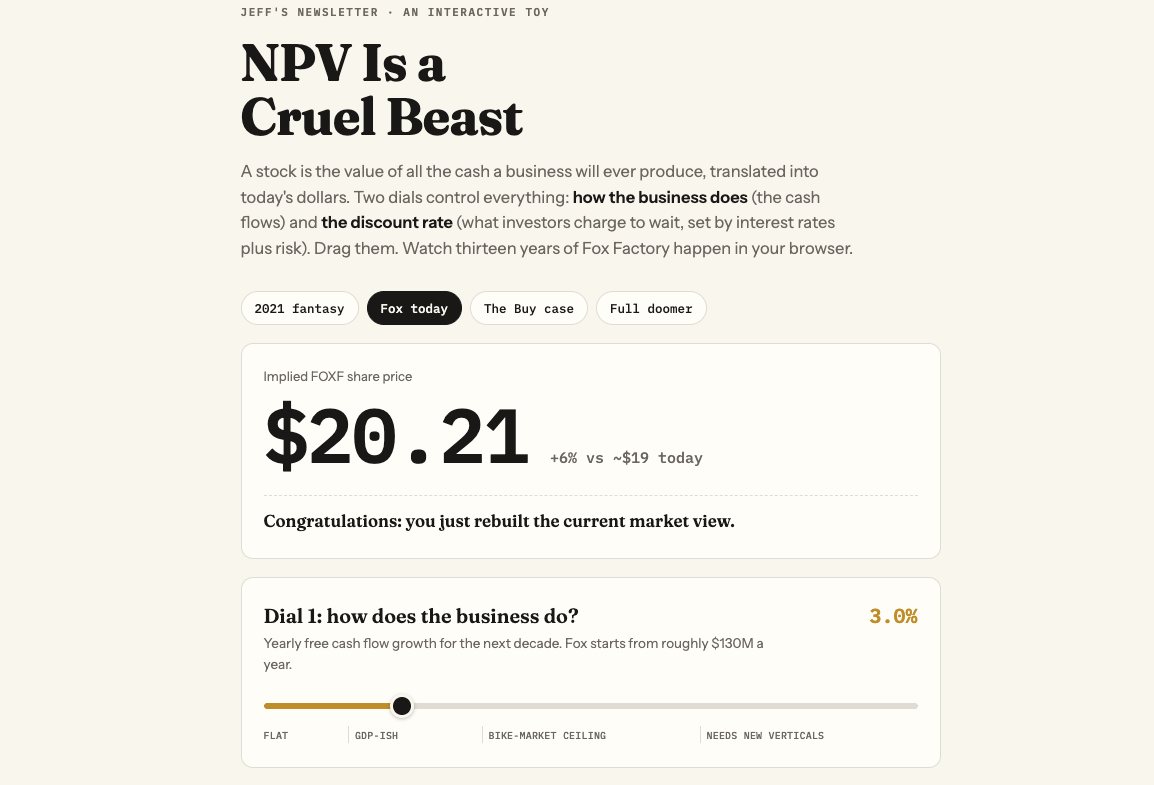
Finance pit stop, the important one: a stock is the value of the cash the business will generate in the future, translated into today’s dollars. Translating future dollars into today’s dollars requires an exchange rate (“discount rate”), and that exchange rate is interest rates. Quick gut check: would you rather have $100 today or $100 in ten years? Today, obviously. But how much less is the ten-year dollar worth? That depends entirely on rates, and how risky your future cash flows are. In 2021, with the ten-year Treasury at 1.5% and investors demanding maybe 7% to own a stock like Fox, a dollar of profit arriving ten years out was worth about 50 cents today. At today’s rates, where the ten-year sits near 4.7% and a levered cyclical has to offer more like 11 or 12%, that same future dollar is worth about 30 cents. Nothing about the shocks changed. The discount rate changed, and growth stories are, by definition, made almost entirely of future dollars.
Now add the second blow, the one specific to companies like Fox: rates don’t just change the discount math I showed you above but they also shrink the cash flows themselves, because Fox sells discretionary, elastic goods. Customers finance the truck, finance the side-by-side, and increasingly finance the bike. When money gets expensive, they simply buy less. Numerator down, denominator up, simultaneously, NPV is a cruel beast. I’ll add one more aside here in that its arguable Fox hit criticality their total addressable market. The low hanging fruit was picked right around the time rates went up, which is arguably a “third whammy”.
I am all about interactivity to learn, so I built a net present value calculator specific to Fox. Its hosted on netlify and you can find it here. Below is a screenshot.
Fifteen years ago Bill Gurley wrote the definitive essay on this, “All Revenue Is Not Created Equal,” about what earns a company a 10x revenue multiple: recurring and predictable revenue, high gross margins, low capital intensity, no customer concentration, real pricing power. Run Fox through that checklist honestly and you get: cyclical OEM order books, 30% gross margins, heavy working capital, meaningful concentration in one truck platform (hello, Ford), and demand that moves with gas prices, which is a fine business but not a checklist business. Yet at the November 2021 peak, Fox carried roughly $8 billion of enterprise value on $1.3 billion of revenue, call it 6.3x sales, a multiple the checklist says it never earned. No, the market wasn’t saying Fox was secretly software but was free money distorting demand and making everyone forget the idea of the Gurley checklist exists.
Era two, 2021 to now: revenue is up about 11%. The equity is down about 90%. Fox trades at roughly 1x sales versus 6.3x at the peak, and net debt has gone from about 2% of enterprise value to 43%. Obviously, the business didn’t collapse, revenue peaked at $1.6 billion in fiscal 2022 and this year’s guide is about 10% below that: a rough patch, sure, but not a collapse. What collapsed is the financing structure the equity was priced on. A company valued as an all-equity compounder in a zero-rate world became a company financed substantially with debt in a five-percent world with limited growth potential and the equity absorbed the entire difference.
November 2, 2023
Set the scene. The Fed funds rate is 5.25 to 5.50%, the highest in over two decades. The bike industry is drowning in COVID inventory and Fox Factory walks into its Q3 2023 earnings release holding one enormous asset almost nobody else in the outdoor industry has: a balance sheet with just 0.5x of leverage and a 19.2% EBITDA margin. Nearly unlimited optionality, at the exact moment optionality is most valuable.
In that single press release, Fox announced a definitive agreement to buy Marucci Sports, a baseball bat company, for $572 million, financed entirely with new term debt. In addition they announced a $300 million buyback authorization, up to 8% of the company and a reaffirmed “2025 vision” of $2 billion in sales at a 25% EBITDA margin.
They chose the exact top of the rate cycle to spend the cleanest balance sheet in the industry on something way outside the “strikezone” (sorry I had to). They bought a bat company.
Here’s where those commitments stand today:
Leverage: 3.7x, against a covenant they had to loosen this spring.
Margin: 12.7%. Marucci: management now says, and this dependent clause was not there in May, “while we review the strategic path for this business long term,” they’re running it hard.
The buyback: essentially never happened; share count is flat.
The $2 billion at 25% vision: became 2026 guidance of $1.42 to 1.47 billion at roughly 12.4 to 13.3%.
Revenue 28% under the target, margin at half. The stock is down about 72% since that release.
I want to be fair, because hindsight is cheap. Marucci wasn’t a stupid asset or a bad company, for the right buyer its a great asset with (maybe) real growth, well built by its prior owner. Nobody fully called the depth of the bike downturn (well, this post goes back to October 2023…I’ll take my flowers than you very much), and management doesn’t set interest rates. That said, spending a pristine balance sheet on a diversifying acquisition at the precise peak of the rate cycle is the single most consequential decision this company has made in a decade, and everything you watched in Part I flows downstream from that one document.
The math that makes this existential rather than academic: Fox pays roughly $24 million of interest every six months against $23.5 million of GAAP operating income in the same period. The margin turnaround isn’t a nice-to-have but is rather the mechanism by which Fox buys back the flexibility it spent in November 2023 (or buys some level of freedom back). It’s why a Marucci sale, if it comes, wouldn’t really be a divestiture but more of a rewind: undoing the defining decision of this era, with the proceeds going straight to the debt that funded it.
Oh, and one day before Fox reported this quarter, the private-market version of this exact trade reached its terminal state: Accell Group, the European giant KKR bought for roughly €1.8 billion in 2022, the largest e-bike company in Europe, entered Dutch insolvency proceedings. Same type of trade as Fox, cheap capital and aggregation, run with more leverage and less luck. That one gets its own post shortlym, don’t worry but for now just note what separated the two: The balance sheet, when the regime changed.
The scoreboard nobody in outdoor wants to look at
If the rate story above is right, it should show up across the whole neighborhood. It does. Ten grand invested the week of Fox’s IPO, price only, splits adjusted:
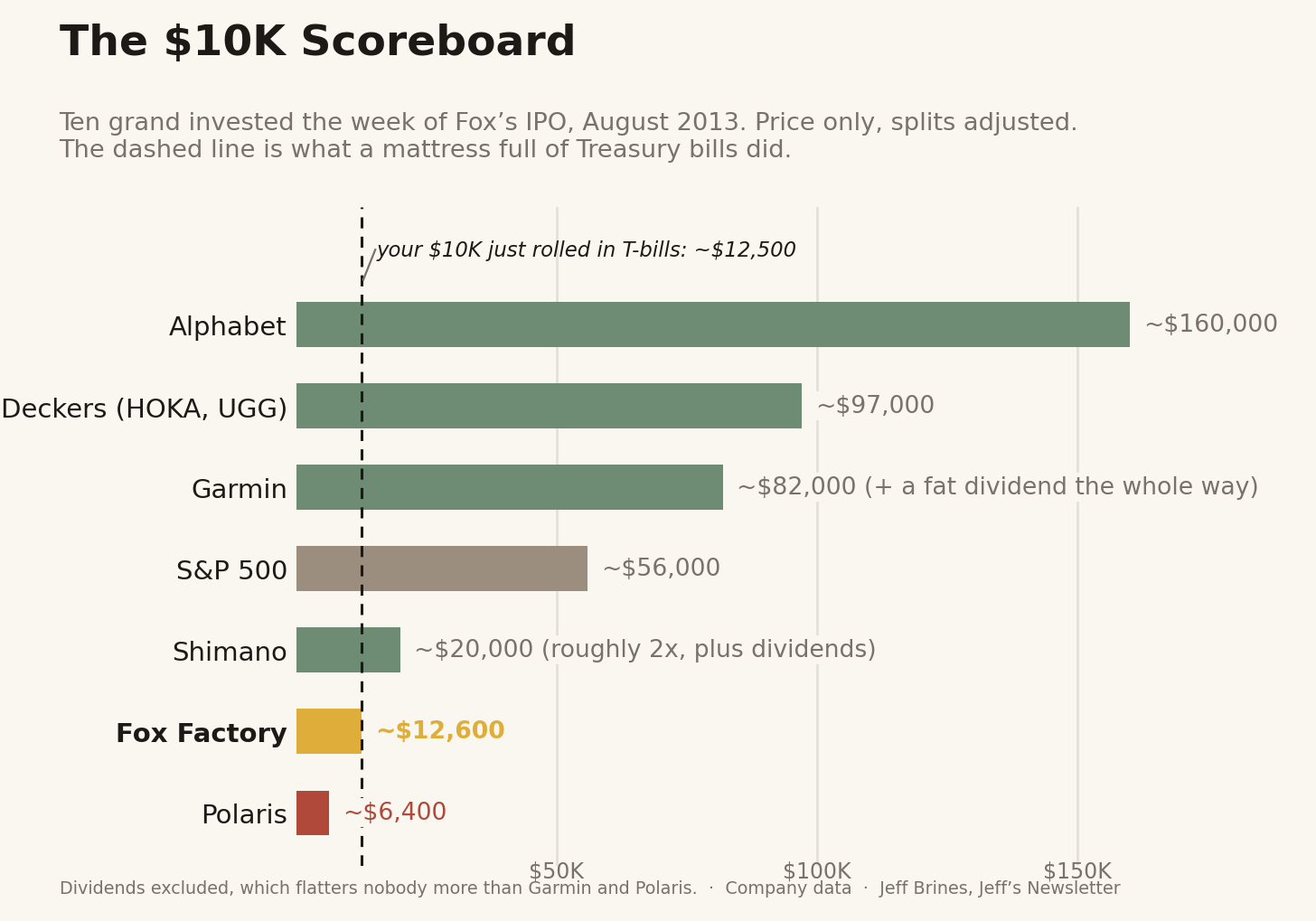
Alphabet is the control group: that’s what a capital-light compounder did over the same window, and it’s why the 2021 market kept trying to price everything, including a shock absorber company, like one.
But the interesting line isn’t tech versus outdoor. Look inside the outdoor-adjacent hardware set. Deckers and Garmin make physical things with complicated global supply chains, and both demolished the index. What the winners share: net cash balance sheets, 20%-plus margins, and pricing power the end customer can actually feel. What the duds share: leverage, dealer and OEM channels, cyclical elastic goods. If you want the extreme proof that hardware is innocent, it’s already sitting in my report card: Ferrari bends metal, runs a supply chain, sells a wildly discretionary product, and compounds like software anyway, because 39% margins and a waiting list mean demand elasticity is exactly zero. Elasticity against commoditization is the disease but hardware was never the problem.
That’s the real lesson of Fox’s lost decade, and it generalizes across every bike brand, component maker, and retailer you follow: this industry is full of fine businesses that were briefly priced as great ones, and the tide that’s gone out since 2021 has been sorting them by margin structure and balance sheet ever since, one bankruptcy at a time.
Where Fox Goes From Here
To start, and to state the obvious, as things stand Fox doesn’t need to know which motor wins. Avinox, Bosch, Gobao, the analog bike, 32” wheeled bikes… all of it needs suspension, and management called its strategy “motor agnostic” on the call. That’s the arms dealer play during a platform war. If China takes the motor, the battery, and the drivetrain, suspension is one of the last high-value components on a mountain bike still controlled by a Western supplier.
The bull case, in three sentences. Engineering is the DNA and they’re still feeding it (R&D up while everything else got cut), and the product is more than spring-and-oil alone with the addition of software-defined control, where an ECU designed in years before launch is an annuity with real switching costs, Tier 1 style, especially on powered side of things. The high end may be a bright spot, the top of the K doesn’t ask the price (again, Ferrari). The story simplifies from here: non-core assets go away with proceeds straight at the debt, while suspension travels somewhere new (e-moto, EVs, dirt bikes, the autonomous award, the industrial pipeline).
The bear case has a new character in it, and it speaks Mandarin. Fox’s moat is relationships and validation, not physics: Push, Vorsprung, and EXT prove small teams can match the dampers; Öhlins, now owned by Brembo, a company with exactly Fox’s OEM DNA, can match the validation; RockShox already splits the OEM market. The new China, the DJI China that builds at scale like nobody alive and graduates STEM PhDs at twice the US rate, loves to verticalize and could simply come for suspension. “Riders won’t trust Chinese suspension for years” is what everyone said about Chinese motors, eighteen months before Avinox sold out. Heavier e-bikes lower the bar, too. I’m not saying this is going to happen, but if it’s good, it’s good. I’d ride it, and so would you.
If I’m a shareholder I want to see some more aggressive spend on R&D, some noodling on new revenue channels and obviously…clean up the balance sheet.
What I’m watching
The Q4 print. 15.6% at the midpoint. Land near it and the cost-out thesis is validated, and I’ll say so plainly. Come in at 12 to 13% and two years of restructuring will have produced roughly the margin structure it started with.
Whether 3.0x comes back. A number on the Q3 call means confidence. Adjectives mean the opposite.
Whether “sold out” stays sold out. One quarter of scarcity is a datapoint. Two is a trend, and a very big one for my e-bike thesis.
The thrice-delayed volume. Bats, bike normalization, F-150 chassis. All were supposed to happen already, all moved right once.
Marucci. The dependent clause is doing a lot of work.
China. Always. They could jump in.
Closing
Through the zoom lens, this was a good quarter. The margin inflection is a step in the right direction, the cash generation important, the engineers stayed funded, and the working capital discipline nice to see. It’s also a quarter that concentrated an entire year of proof into a thirteen-week window starting in October, while a leverage target looms in the background (that apparently only I care about).
Through the wide angle, the frame is harsher and more useful. Fox ran the defining trade of the last decade: cheap capital pricing a good business as a great one. When the regime changed, rates spiked, future demand shifted, the equity absorbed the whole adjustment, down 90% on revenue that’s up 11%. Fox entered the downturn holding the one asset most peers didn’t have, a nearly debt-free balance sheet, and spent it in November 2023 on a baseball bat company. Everything since is the work of earning that flexibility back.
Operational improvement is necessary and lever pulling will be required. What’s sufficient is runway, and runway is the thing Fox mortgaged. Anyone who follows this newsletter probably recognizes this, but when you look at any bike brand, component maker, or retailer from ~2023 to now, the first question isn’t just about the product, but rather it’s how much time they have, and who decides when it’s up. Then its “what are the options”.
This is the new normal. Outside of one big Chinese company and a handful of insulated boutiques, I don't think anyone in this industry is sleeping well. There's likely turbulence yet ahead.
See you out there.
Disclaimer: This is analysis and opinion, not investment advice. I have no position in FOXF at the time of writing. As always, do your own research. If you enjoy this kind of content, subscribe and share, it’s the best way to support what I’m building here. If you want help with your company, check out my CFO consulting firm GuideRail or put me in front of your hardest business problem as a forward deployed software/AI engineer. My email is jeff.brines@gmail.com or jb@guiderail.io. Reach out anytime.
Sources/Addendums
All charts/graphics made for me by Claude Fable 5. Edited and fact checked by Claude Fable 5, GPT 5.6 and Kimi K3. Yes, I’m a total AI nerd, software engineer and believer in the future.
Fox filings and calls:
Q2 fiscal 2026 press release (August 6, 2026), plus the earnings webcast replay at investor.ridefox.com
The November 2, 2023 press release: Q3 2023 results, the Marucci acquisition, the buyback, and the “2025 vision,” all in one document
Fiscal 2023 results and fiscal 2022 results, for the old-era margins in the charts
The rest of the industry:
Polaris Q2 2026 earnings call, for the 2.6x leverage figure
Amer Sports fiscal 2025 results, for the 0.3x leverage figure
Accell enters Dutch insolvency (Bloomberg), and the escalation to formal bankruptcy (Bicycle Retailer)
Brembo’s acquisition of Öhlins ($405M, completed January 2025)
Frameworks and data:
Bill Gurley, “All Revenue Is Not Created Equal: The Keys to the 10x Revenue Club” (2011)
Historical share prices via Macrotrends, split-adjusted
Finally, my Favorite Video on EBITDA (“EBITDA = Bullshit earnings); Warren Buffet/Charlie Munger