In October of 2014, just four months after going public, GoPro was the darling of Wall Street. Its stock had surged to nearly $94 a share and the company was selling cameras as fast as it could make them to an attention-hungry public. You couldn’t go to a ski resort or a trailhead without seeing droves of them strapped to people’s heads, chests, and wrists. The company had caught fire, and it had created an entirely new consumer space: the “action camera.”
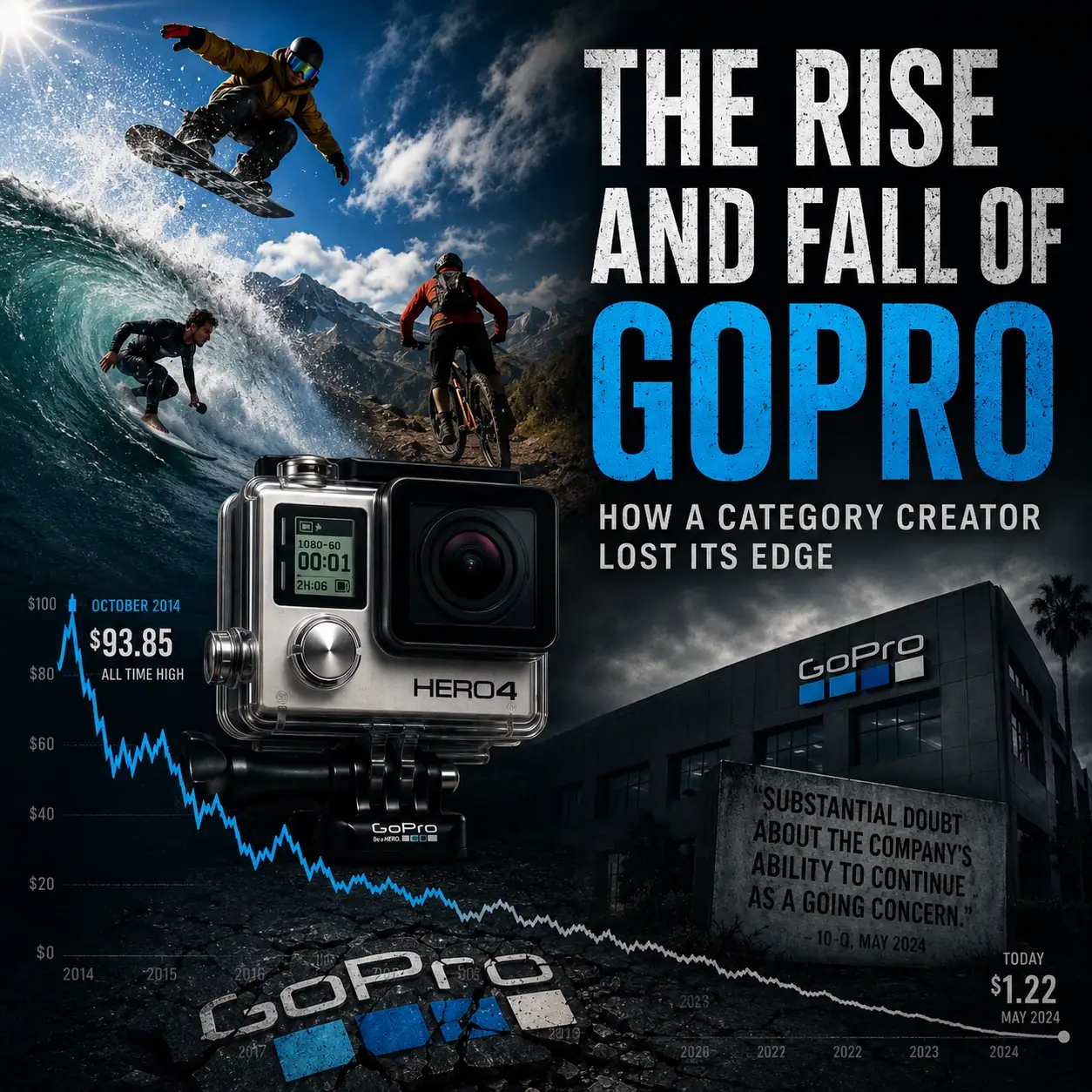
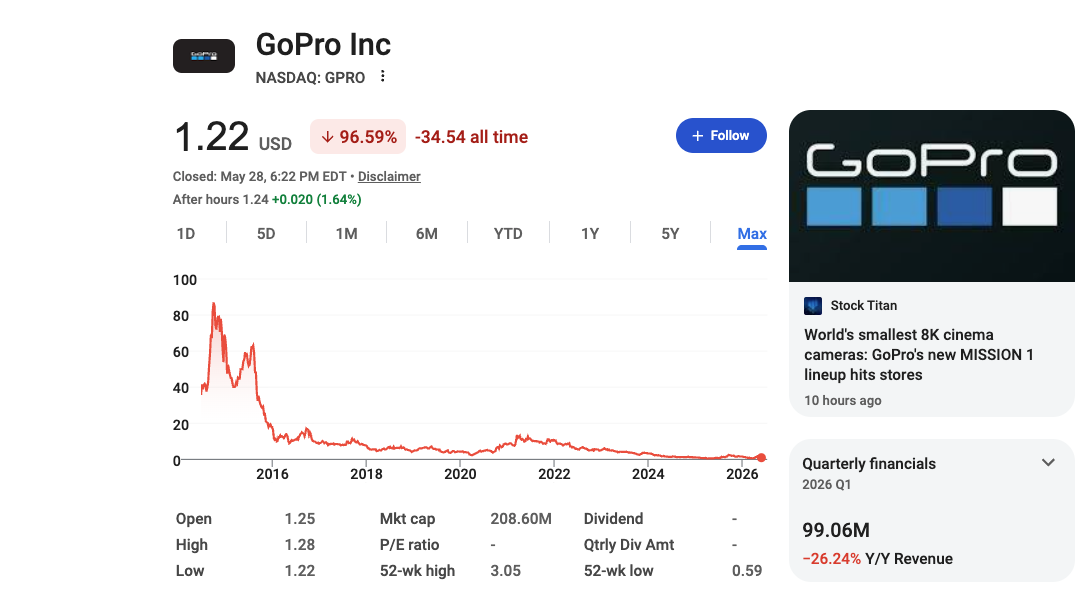
Today GoPro trades at roughly $1.22 per share. The market cap is around $200 million, which is less than the company did in revenue in a single quarter at its peak. In its most recent 10-Q, management used the words every operator dreads: “substantial doubt about the Company’s ability to continue as a going concern.” On May 11 the board authorized a review of “strategic alternatives,” retained the investment bank Houlihan Lokey, and on the earnings call founder Nick Woodman named a potential sale of the company as one of the options on the table. For the uninitiated, these are all bad signs. In plain English, a “going concern” means there there is substantial doubt the company will survive the coming year.
GoPro did almost everything a brand is supposed to do. It invented a product category and built a defined an era of action sports. It became the generic noun, and the verb, for the thing it made, the way Kodak was film and Xerox was copying. People don’t say “I filmed it on my action camera.” They say “I GoPro’d it.” That is the holy grail of consumer branding, the thing every CMO dreams about, and GoPro crossed the chasm.
So how did a company that won the branding war this decisively still end up here? The short answer, which I’ll spend the back half of this piece unpacking, is that GoPro had no real response to the barbarians at the gate (DJI, Insta360, and the phone in your pocket), and kept pointing real talent and real money at the wrong problems. This is less a story about hardware being hard, though it is hard, and more a story about misallocation of resources and aim.
A quick disclaimer before I get into it. This is not a eulogy and it’s not a dunk on Woodman or the talented people who work there. The company was the darling of the mid 2010s in the action sports space and the product was genuinely great. I’ll always look back fondly on my “POV days”. The goal here is to tell the story of GoPro and try to understand what actually happened. How did they lose? What led here? What could they have done differently? And of course, we have the benefit of hindsight which is to say its about 1 gagillion times harder to make all the right decisions when they count.
Let’s start with the story…
Origins
Nick Woodman was a surfer with two failed startups behind him, an e-commerce site and a gaming company, both dead, when he went on a surf trip in 2002 and couldn’t find a good way to film himself riding. As the story goes, he tried rubber-banding a camera to his wrist. He funded the early days selling bead belts out of his van, plus a loan from his father and an investment from his mother.
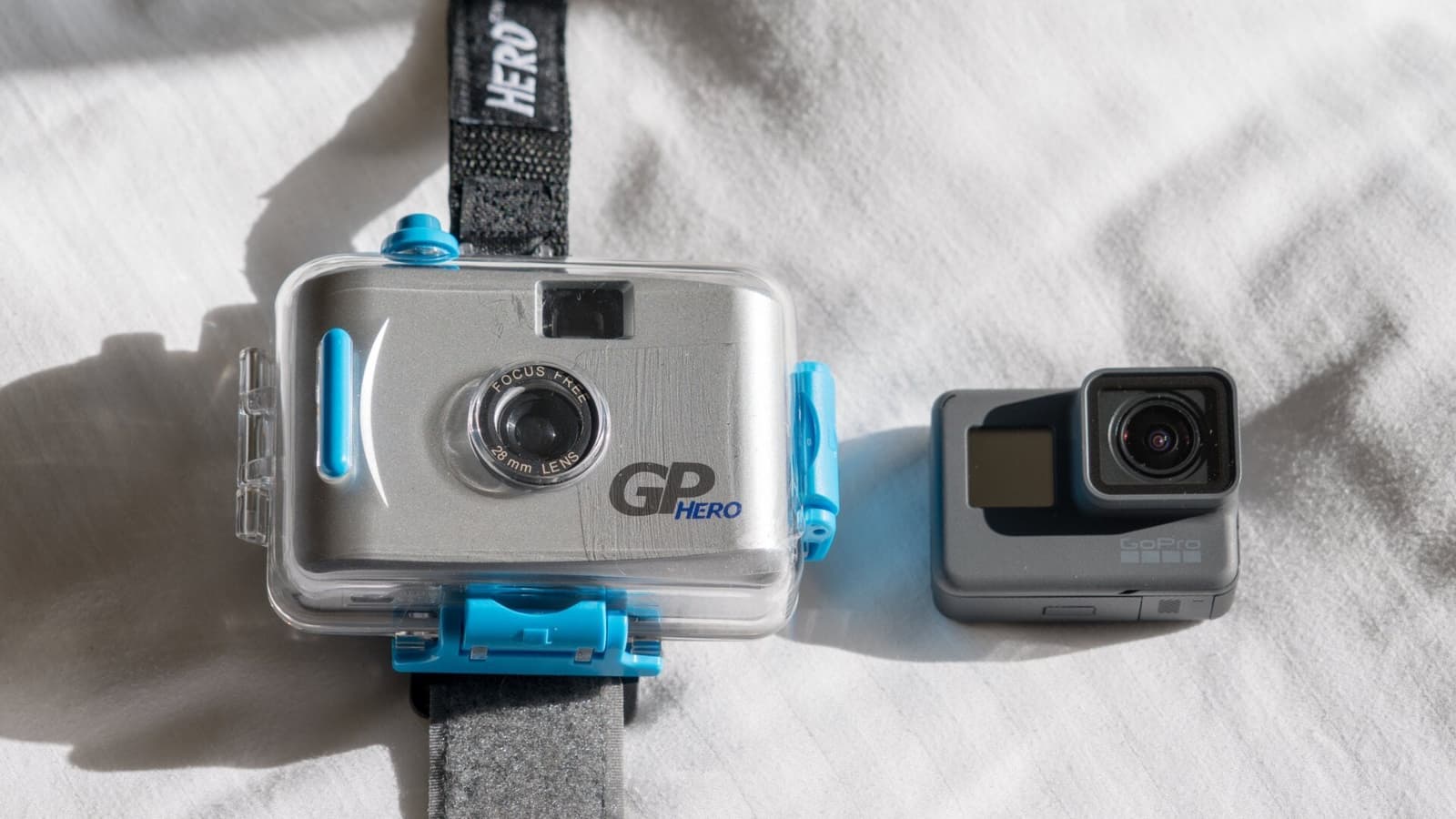
The first GoPro product, in 2004, wasn’t even a camera GoPro built. It was a rebranded 35mm film camera sourced from a Chinese manufacturer, bought for around three dollars, fitted with a housing tweak and a wrist strap Woodman designed, and sold for twenty to thirty bucks in the back of surf rags. The innovation was really in the strap, mount, and the insight that surfers and skiers and skydivers desperately wanted a rugged, wearable, camera that nobody was selling them. Woodman had fallen in love with a problem, and it was a good one.
Editor’s Note: Somewhere on a camcorder is footage from 2006 of me attempting to POV a local trail around Denver. I had to put my family’s digital camcorder in a backpack and duct tape a secondary lens to my helmet. It worked. Barely. But it worked.
The Rise
The real inflection point was the HD HERO in 2009. Putting 1080p into a wearable cube democratized cinematic action footage in a way that had simply never existed. Amateurs could suddenly capture broadcast-quality first-person video, and they did, by the millions.
The way GoPro grew was as impressive as the early products. Unlike their competitors at the time (remember Contour?) they were the Red Bull of the space. Instead of buying ads about megapixels, they handed free cameras to athletes in exchange for the footage rights and turned that footage into a self-replenishing river of content that the world had never seen. They built the GoPro Theater at trade shows, looping awe inspiring athlete clips on big screens gawking crowds. They ran the Million Dollar Challenge, effectively paying users to flood the internet with footage shot on the latest Hero. The customer did the marketing, and they were early to the UGC trend, leveraging early video networks like YouTube and Vimeo. By 2013, GoPro sold roughly 3.8 million cameras and held something like 45% of the entire US camcorder market. Revenue went from $234 million in 2011 to $526 million in 2012 to nearly $986 million in 2013. This is one of the steepest hardware ramps Silicon Valley had ever seen.
GoPro defined an era. My POV edit circa 2014.
The IPO
GoPro went public in June 2014 at $24 a share, valuing the company near $3 billion. By October the stock hit $93.85. The reason the multiple ran that high is the market wasn’t pricing GoPro as a hardware maker, because hardware didn’t get those multiples (in those days). It was pricing GoPro as a media company, betting that all that user content could be spun into a recurring, high-margin revenue stream.
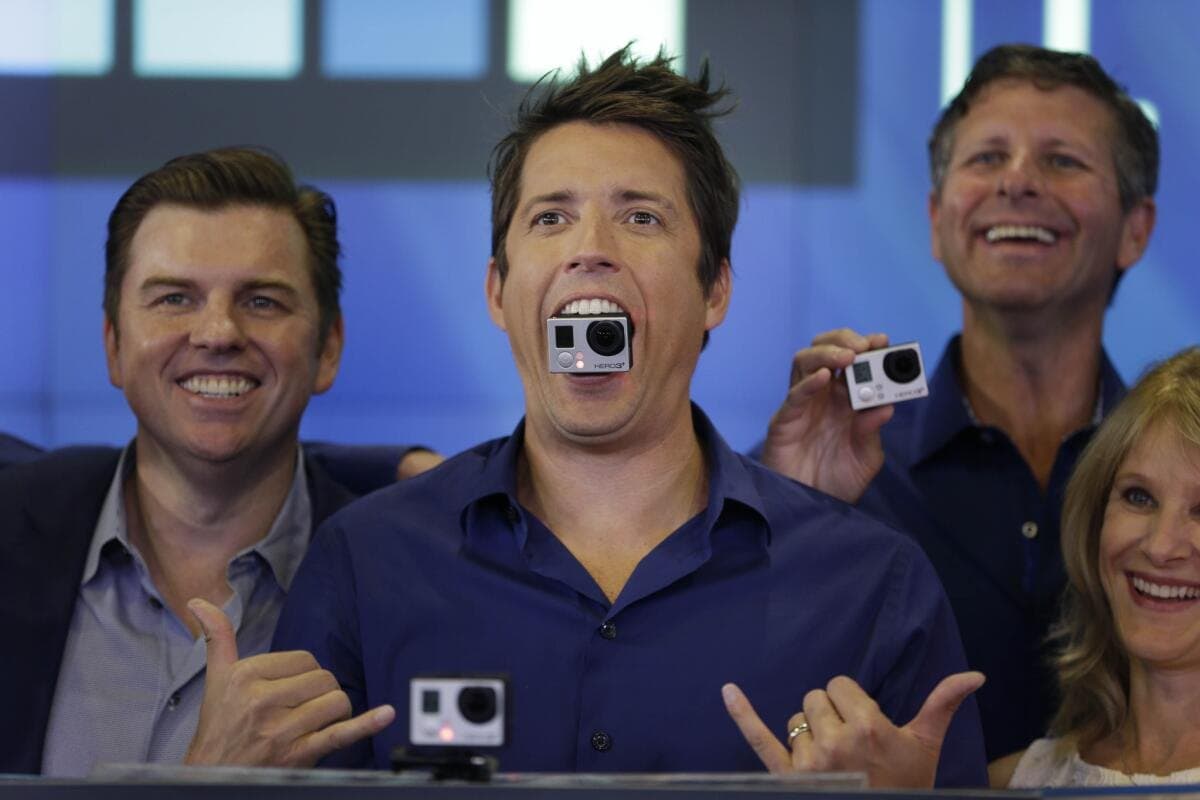
GoPro seemed to believe it too. Starting around 2012 and accelerating after the IPO, the company tried to become an entertainment business, hiring senior TV and tech executives, standing up a content division, and building channels on Roku and Xbox. It was a misread of its own business and the first misallocation of resources. Woodman lost sight of the problem his team was adept at solving.
The early content was phenomenal as marketing, as fuel for the engine that sold cameras. People had simply never seen high quality POV footage from the world’s best athletes. However, as anyone reading this knows POV gets tiring and by itself is not storytelling. Hence, GoPro quickly learned it was not a standalone media company, and by early 2017 the division was shut and about 200 people were cut.
The hardware stumbled in this stretch too. New variants that were not notably better than the prior variant, at least to those viewing the footage. GoPro had overbuilt inventory on the assumption that growth was permanent, then had to slash the price twice and eat nearly $100 million in price-protection charges and write-downs. The brand, it turned out, could not hold a premium price without a clear reason to and return customers not as easy as early data might have predicted.
The Drone
The big swing was the drone, which came about as a result of a kerfuffle between DJI and GoPro dating back to 2013. The logic looked sound: people were already flying GoPros on drones (early DJI products) to get aerial shots, so why let someone else own the aircraft? In September 2016, after delays, GoPro launched the Karma at $800.
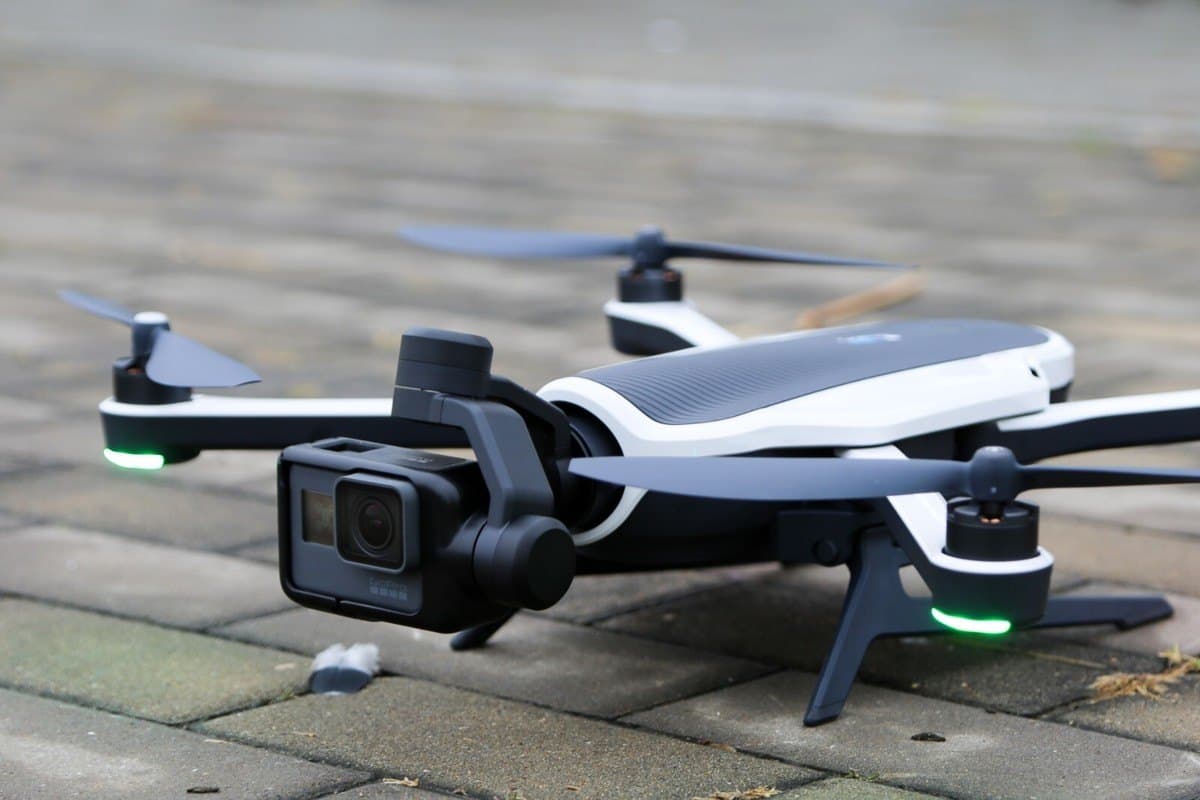
Within the same quarter DJI launched the Mavic Pro which was at least one generation better than GoPro’s drone. It got worse for GoPro: sixteen days after the Karma went on sale, units started losing power mid-flight and falling out of the sky. A faulty battery latch. GoPro recalled all 2,500 units, missed the entire holiday season, and limped the product back in early 2017 before exiting drones entirely in January 2018, blaming a “hostile regulatory environment,” an excuse widely mocked given that DJI was thriving under the exact same rules and went on to take roughly 70% of the consumer drone market.
The Grind
From 2018 on, GoPro was a pure camera company in an increasingly brutal squeeze. The smart phone continued to eat the casual user from below. DJI, swearing to bring GoPro to its knees following the deal gone south in the pre-IPO days, brought the Osmo Action straight at GoPro in 2019 with bigger sensors and better low-light, and Insta360 owned the 360 category GoPro tried and failed to win with its Fusion and Max. GoPro kept iterating the Hero, but the leaps got smaller every year and again, the company lost site of the problem. How can we make action cams a better user experience for the customer?
The company tried to pivot (or rather, add) to a subscription model: cloud storage, the Quik editing app, camera replacement, and discounts, bundled for a recurring fee at 70%-plus gross margins versus the low 30s on hardware. Subscribers grew to around 2.5 million, but this number is likely inflated in that the subscription was often bundled for free at the point of sale.
Today
In the first quarter of 2026, revenue fell 26% to $99 million, camera sell-through dropped 29%, and the subscriber base, the supposed lifeline, fell 8%. Gross margin collapsed to 4%. The net loss was $80.8 million. Stockholders’ equity went negative, the debt got reclassified as current ahead of expected covenant breaches, and the going-concern warning followed.
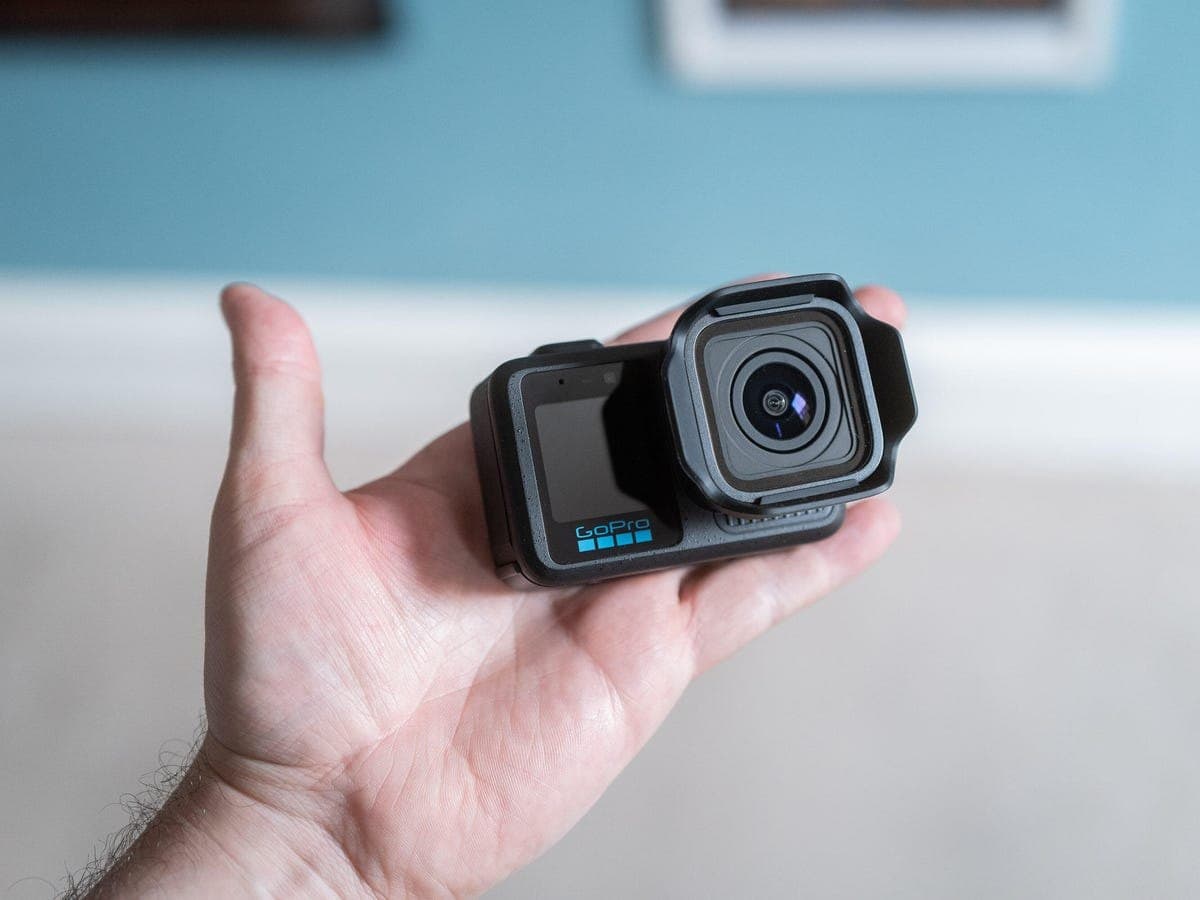
GoPro’s answer is the MISSION 1 series, shipping at the end of May: a high-end push with a one-inch 50-megapixel sensor and even an interchangeable-lens cinema model. It’s a capable camera and a clear retreat, trading a giant commoditized market they were losing for a tiny premium one they might hold. There’s an attempt at an aerospace and defense pivot too, leaning on the fact that GoPros have flown on NASA’s Artemis II, plus brand collaborations with ASUS and Dick’s. It all has the feel of merchandise being arranged in the shop window before a sale, which, with Houlihan Lokey running a strategic review, is more or less what it is. There is no direction, and last I checked, nobody I know is looking for anything remotely like the MISSION 1 though I do hear chatter in the FPV market that it may be a good onboard camera for certain types of drones (ironically).
From my perspective, the only way MISSION 1 works is if the company can restructure around a much smaller market and much smaller endpoint. This is the camera a camera nerd might buy after they have an action cam, a 360 cam, a drone, and an SLR. I struggle to see how it replaces any of these, and I’m not sure when, exactly, I’d take it out. (and I’m a nerd)
What they were actually good at
GoPro’s superpower was never the camera. It was the marketing flywheel in a different era. Selling a lifestyle instead of a spec sheet, and getting customers to produce the advertising, was a genuine work of genius and it’s what minted the brand. However, good marketing has a specific limitation that turns out to be fatal: it drives demand, and it does nothing to defend. There are basically no switching costs on an action camera. The marketing engine made people want a GoPro this year but it did nothing to stop them from buying something better or cheaper next year, or from skipping the category altogether when the camera sat on the shelf due to a poor user experience.
The usual story of GoPro’s demise is “phone cameras got good enough.” Which is clearly true, but it undersells the threat a touch. Every year since the inception of the brand, hundreds of millions more capable cameras shipped in people’s pockets. The market for a dedicated action camera quietly shrank to the residual of moments a phone genuinely couldn’t get, the underwater, the helmet, the handlebar. For the casual majority, the reason to own a separate camera simply evaporated and the “action cam” became more and more a niche use case. As an aside, it also turned out to be very challenging to capture compelling POV footage such as the footage below.
Obligatory SkiChef/CB post. These types of videos worked amazingly well, but it took a ton of time and talent to get there.
There is another elephant in the room that should have riddled GoPro’s entire product team with perpetual anxiety. Even when you did shoot on a GoPro, the footage had a long journey to go before it could be shared, often requiring the user to scroll through hours of content to find ~60 seconds of something share-worthy. In contrast, phone clips were easier to work with, often shorter, and required zero transfer, especially as short form video apps started to go viral. The phone became the mandatory middleman for everything GoPro captured. It won the last mile no matter what and in many ways, phone based footage lended itself to easier storytelling.
When peering back through the lens of history, GoPro looked like a technology company but was in fact more of a “D2C style” widget of the day type of play, more in line with Solo Brands than DJI.
Rate of change: theirs flattened, DJI’s never did
For the first decade, GoPro did improve, each Hero a real leap over the last. Then the improvements flattened. My own Hero 10 still shoots great, which sounds like a compliment until you realize its old enough to be in 1st grade. When this year’s camera is hard to distinguish from one many years old, there’s no reason to upgrade.
DJI’s rate of change never flattened. While GoPro made the same cube marginally better, DJI was on a relentless cadence across an expanding portfolio, pushing sensors, stabilization, and entirely new form factors year after year. They built an entire ecosystem of amazingness, in housing much of it. GoPro defended one product while DJI built an empire: drones, the Osmo Action to fight GoPro head-on, the Osmo Pocket aimed at the everyday vlogger, the wearable Osmo Nano that is essentially “a GoPro but smaller and from DJI,” a microphone ecosystem, gimbals, and as everyone reading this knows, electric bike motors. Heck, they even have a heavy lift system for tough-to-access construction projects.
DJI and Insta360 simply out-engineered GoPro, each getting truly great at something specific and hard to copy: DJI at the full imaging-and-flight stack, Insta360 at 360 capture and stitching. GoPro was good at a lot of things but they were outmatched from an engineering standpoint. When you roll all this together, its hard to see how this doesn’t end in a going concern.
The elephant in the room
The biggest miss wasn’t hardware at all, and it was sitting in plain sight the entire time. Here’s the lifecycle of a real GoPro customer.
Buy the camera → use it constantly for about a month → go to actually do something with the footage → discover it’s a miserable slog. It quite literally feels like a job → clips pile up on an SD card or a hard drive → edit they imagined never gets made → over it → camera drifts into a drawer and is seldom used onward.
The user churns and never upgrades. Maybe they use it in a pinch here and there, the ski trip to BC or a fishing adventure to Baja but the user is left almost feeling cheated. The thing was never really delivering on its implicit promise, which was never “capture video,” it was “tell the story of my adventure.”
GoPro nailed the moment of capture and abandoned the customer at every step after it. They never verticalized a pleasant (dare I say “fun”) experience from capture through to a finished, shareable story. When TikTok and Reels turned short-form vertical video into the dominant language of the internet, GoPro, a company whose entire business was video capture, had no answer. The footage was trapped on a device, in a format and a workflow that fought the platforms where people actually wanted to share. Heck, even trying to decide “do I shoot horizontal or vertical” became an anxiety point for users like me. The single most important job, helping people turn raw clips into something worth posting, went unsolved (and remains unsolved) for fifteen years.
This is where the founder’s instinct went missing. Woodman fell in love with a problem in 2002, and it built a billion-dollar company. But somewhere after the IPO, GoPro stopped hunting for problems and started chasing categories other people were already in. They became memetic. Copying what was around them instead of thinking in first principles.
First in media, because that’s where the valuation pointed. Then drones, because that’s where the hype was. Gimbals, because footage had to be more stable. All were imitation, not problem-solving, and imitation is how you end up entering DJI’s category against DJI. The one problem that was uniquely theirs to solve, the one nobody else was positioned to touch, was the editing problem. And they walked right past it.
The road not taken (and the one they’re on)
By its own disclosures, the company has more than 13 million hours of footage in its cloud, plus millions of users who own both the camera and the app. That is a unique asset, the kind a competitor cannot simply buy or copy (even if most of it is trash footage).
The obvious move, the one staring them in the face, was to use this footage as training data to build an intelligence layer on top the footage. I’d suggest the company starts with simply building a cloud based logging tool where it auto-tag’s every clip with what’s in it, where it was shot, what’s happening, timestamps etc. This opens the door to natural language editing. IE “Bring my best powder day footage from last year into a timeline” or even further, “make me a 90-second edit of my best powder days from last winter.”.
The ChatGPT moment was many years ago now, how did they miss this? AI changes everything. Natural language in, finished story out, built on footage you already own. That could be a defensible, high-margin software product sitting on a proprietary data asset perfect for post training, and it’s the exact answer to the elephant in the room.
GoPro had every ingredient needed to build “natural language editing” and its the thing that could have saved GoPro.
What did GoPro actually do with those 13 million hours? Per its own disclosures, it began renting them out as training data for other companies’ AI models. Woof. Holding a legitimately good dataset, GoPro chose to sell the raw ore to other people rather than doing something with it themselves. It’s the media-company mistake one more time: monetize the asset in the laziest, most derivative way instead of building the thing only you could build that literally could change the space.
But Jeff, this sounds hard, are you sure they could do this? Yes. 1000% yes.
Lowly me built a crude version of it myself, over a single weekend, on a Mac Mini, for free, using open-source models. It ingests video, “watches” it frame by frame, transcribes the audio, and tags everything into a searchable database so you can actually find the clip you want years later. It’s slow and bare-bones and nowhere near production. Its a candle in the sun compared to what GoPro could have built. But it works, and it proves the primitive is within reach. If a dude in Idaho can prototype the concept in a weekend, a camera company with 13 million hours of cloud footage, a real software team, and the most recognized brand in the category could have built the real thing and owned it.
I realize this is a lot of Monday morning quarterbacking, and that can be cheap. Maybe this would not have worked. Building truly novel software is hard, and turning messy personal footage into clean, shareable stories is not a trivial problem. But that is exactly why it mattered. This was the hard problem sitting at the center of GoPro’s business. If the goal was to keep people using the cameras, give them a reason to upgrade, and turn the subscription into something customers actually valued, this is where the company should have aimed.
The conclusion…
The masses turned the company’s name into a verb, which is supposed to be the most defensible position in all of consumer products.
It defended nothing. The phone ate the bottom, DJI and Insta360 took the top, the hardware was good but never best at anything that couldn’t be copied, and the one asset that was truly GoPro’s alone, all that footage and the relationship with the people who shot it, got rented out for scrap instead of built into the product that might have saved them.
The lesson for anyone building in outdoor, in hardware, in any category where a strong brand can lull you into thinking you’re safe: being the noun is not the same as being defensible. Ask what you own that a competitor can’t buy or copy. If the honest answer is “a logo and a great marketing flywheel,” you have a brand, which is one of the hardest moats to defend
Maybe instead ask whether you’re still solving the customer’s real problem or just shipping the next version of the thing that first made you famous. GoPro stopped hunting problems, and it spent twenty years and a few billion dollars proving the difference.
Jeff Brines is an advisory CFO in the outdoor and consumer products space (www.guiderail.io), writes this newsletter, and spends at least half his week building agentic systems for businesses. The views here are his own. If you found this useful, share it with someone who needs to read it, or email him at jeff.brines@gmail.com.