Covering roughly Oct 7 to Nov 6, 2026.
Those interested, all of this is aggregated from my own personally built newswire which you can find following this link. If interested in how I built it, please ask!
We’ve been paying for the pandemic boom through a steady stream of bankruptcies, consolidations, repricings and restructurings since 2023. But the last 30–60 days have felt like one massive balloon payment coming due all at once.
I tried to avoid using the word “COVID” in this post because it feels like ancient history at this point, and tracing today’s problems back to events nearly five years ago can feel like a stretch. That said, much of what’s happened in the outdoor industry since the leaves started turning colors leads directly back to that period and it’s a connection we can’t ignore.
The problem runs much deeper than the oversupply crisis that kicked all of this off. Brands that raised capital during the boom are now confronting a very different world: a bifurcated consumer market, structurally higher interest rates, and capital markets (far) more interested in funding anything with the letters “AI” attached to it, rather than bikes, skis, or just about anything else.
The pandemic may have started the chain reaction, but the economic environment that followed has made the fallout considerably worse.
The month in five bullets:
Europe’s bike industry is being sold in pieces. Accell’s brands went to Asian buyers, mostly for the brand and the inventory, not the factories. Bianchi and Lapierre are in court-supervised restructuring. Ghost appears to be picked up by an Asian company as well.
Fox took strides toward fixing its balance sheet and fired its CEO in the same month. Marucci sold for $225M, leverage fell to about 2.4x, and the board brought in an interim operator. Q3 results were meh, but that was expected following the preannounce in October.
Shimano says the bike glut is over, except in America. Europe and Asia are recovering. The US is stuck because tariffs have pushed bike prices too high.
Tariff refunds made a lot of earnings look better than they were. Fox, Thule, Columbia, Deckers, Puma and others all got a lift, but it should be ignored. The real question is what a blue wave might mean macro-economically and for global trade.
Ski is having a demand problem and a governance problem. Epic Pass units are down about 12%, Oasis is running a proxy fight at Vail, and the season started slow.
Jeff's Newsletter is a reader-supported publication. To receive new posts and support my work, consider becoming a free or paid subscriber.
Europe’s bike industry is being sold for parts
The biggest bike story of the month was Accell, once Europe’s largest bike group, being broken up in bankruptcy. Here’s where the pieces landed:
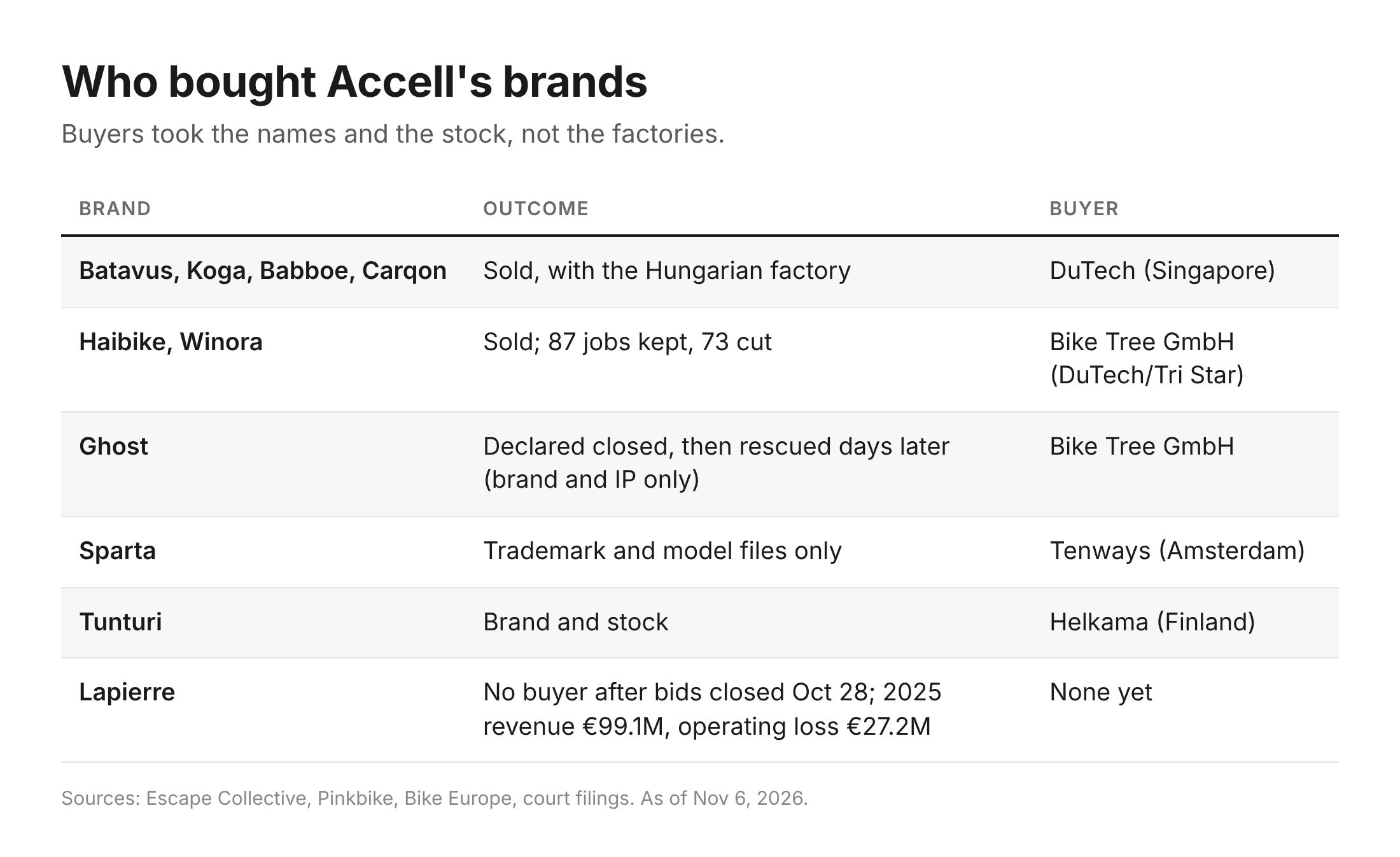
It appears buyers want brand names, IP and inventory but they don’t appear to want the factories, the overhead or the people. Ghost is the starkest example: supervisors said no offer beat simply liquidating the stock, and 53 jobs were cut, before Bike Tree bought the name anyway. I did a little homework and the Accell deal is KKR’s ~5th worst loss of all time and probably ranks somewhere in the top 30 worst PE deals of the modern era. If you thought outside capital was scared to enter the space a year ago, this probably puts a nail in the coffin of PE coming in outside of something like backing an Avinox (DJI) style mass scale operator.
Anyway, it wasn’t just Accell:
Bianchi entered court-supervised debt restructuring in Italy. It owed about €100M at the end of 2024 and lost about €28M over three years. Its interim CEO said the company was “too ambitious in too many segments.”
Pon, the world’s largest bike group, is closing Cannondale’s Connecticut headquarters after 55 years and moving it to the Netherlands. US sales move to Santa Cruz, and reps will now sell Cannondale, Santa Cruz and Cervélo together. A day later, Juliana was folded into Santa Cruz.
France has seen about 200 bike companies enter insolvency proceedings in the past year, the most since 2008. Bastille Cycles joined them on Oct 29.
Edinburgh Bicycle Co-op was sold out of administration to its own managing director, keeping four stores.
The owners who are still standing are cutting structure rather than waiting for yesteryear to come back, because its not. I should probably do a post on this, because I think its more nuanced than “COVID is responsible for all of this”, though of course we can draw a trace back to the pandemic. As with most things in markets (and life), “its complicated”.

Fox Factory: safer but an unclear future
Fox had the most eventful month of any public company I follow, but almost none of it happened on earnings day which was last Thursday. It closed it’s ball sports unit, Marucci, on Sept 25 for $225M, about 39 cents on the dollar against the $572M it paid in 2023, and used the cash to take net leverage from 3.7x to about 2.4x. I did a whole post on the sale here.
Three weeks later, on Oct 16, Fox pre-announced Q3, cut guidance and replaced CEO Mike Dennison with board member Doug Grimm on an interim basis. Corporate speak of “he stepped down” really means they fired Mike. As I posted elsewhere, Dennison accumulated an estimated twenty odd million in gross economic compensation and retained equity value while shareholders who bought at the beginning of his CEO tenure lost roughly 81% of their investment. Ouch. The stock fell about 13% the day they announced his departure.
So when Q3 came out this week, there wasn’t much left to learn. Sales of $338.4M and adjusted EBITDA of about $38M (excluding tariff refunds) landed right inside the ranges Fox gave on Oct 16, at the low end on profit. The only “beat” was against Wall Street’s EPS estimate, again, mostly a ~$12M tariff refund, largely from Marucci, a business Fox no longer owns.
So how does the outlook compare to past performance? Well, comparing today’s guidance to February’s isn’t fair, because February included a full year of Marucci and today’s number only includes it through September.
Here’s a cleaner way to look at it: Since August, Fox has cut its full-year sales outlook by about $80M, and management says about $63M of that is Marucci. So the sales cut is mostly the divestiture. The profit cut is a different story. The EBITDA midpoint fell about $40M, and even if you generously pin $10M of that on Marucci (Fox doesn’t break out its profit), roughly $30M came from the businesses Fox kept. Take Marucci and the refunds out of Q3 and core sales fell about 7%, with margins flat to slightly down. So here we are, two years into a cost program that has found more than $65M of savings without improving profit.
Bikes weren’t Fox’s biggest problem. The trouble was a spring supplier in powersports and a struggling truck upfit business. But bike was “modestly softer than we expected” for a third straight quarter, which lines up with everything Shimano and Giant are saying about the US (more on that below). My honest read is that this is a much safer company than it was in the summer, and a much harder one to value. There’s no permanent CEO, no 2027 guide, an unresolved supply problem, and a market that isn’t paying up for small-cap industrials while capital chases AI. The real test is the February call.
(I wrote a much longer version of this analysis. If enough people want it, I’ll publish it but frankly I’m kind of bored with cosplaying equities analyst for fox...a company that is kind of a dud when it comes to markets and how its being run)
Shimano says things are turning, just not in America
Arguably the most important bike data point of the month came from Japan. On Oct 27 Shimano raised its full-year guidance for the first time this year, lifting its operating profit forecast to ¥54.3B from ¥47.0B. Q3 bike component sales rose 14% to ¥97.0B. Shimano said European sell-through was solid and dealer inventories had improved, led by Germany.
That said, Shimano said North American retail stayed weak in part because tariffs pushing bike prices up, even though inventory here is now at normal levels. In other words, the US problem has changed, something I forecasted going into this season. It used to be too much stock but now it’s prices that buyers won’t (and often can’t) pay.
Digressions aside, everyone else in the bike industry basically said the same thing:
Giant: September revenue up 2.9%, its fifth straight month of growth. Its own brand in China grew 26%, Europe was flat, and the US still declined.
Merida: September revenue fell about 26% on only a 4% drop in units, so it’s getting less per bike, not selling far fewer.
Scott (inside Youngone): First-half sales rose 15% and inventory fell 18%, but it is still losing money. Q3 results are due by Nov 16.
Pon: Bike revenue has slid from about €2.4B in 2022 to about €2.0B in 2025, and Pon said it didn’t expect markets to improve in 2026.
NBDA: The US dealer association asked brands to rethink retail pricing, noting that running a shop now costs 40.4% of sales.
The bike recovery seems to be running at two speeds. Europe and Asia are climbing out, even if its a very modest pace. Meanwhile, the US is flat, and with the last Section 301 exclusions for helmets and trailers expiring Nov 9, tariffs aren’t getting any lighter*
*We will see if the midterm elections and “blue wave” changes things on the tariff front.
The tariff refund sugar high
In February the Supreme Court ruled that the IEEPA tariffs were illegal, and refunds started flowing this spring. More than 75% of roughly $166B in struck-down tariffs has now been paid back. This earnings season, that money showed up all over the outdoor industry.
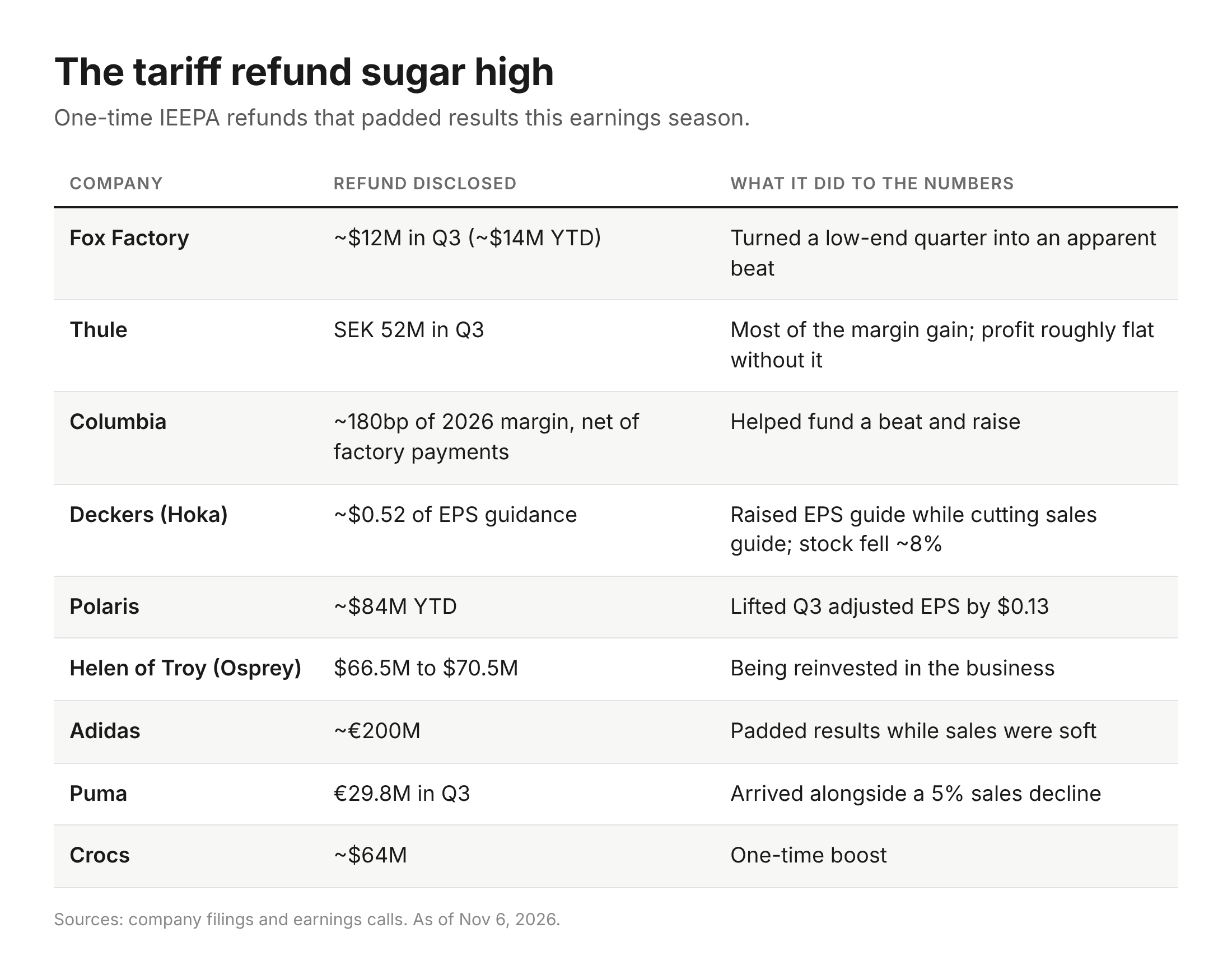
This money is not recurring. Fox, for one, says it isn’t expecting meaningful refunds from here. So when you compare a 2027 quarter with a 2026 one, many companies will be lapping a one-time gain. Several management teams, Columbia’s among them, are already calling 2027 margins uncertain because of new tariffs and rising freight and materials costs. Stifel expects input costs to take nearly a point of margin off active-lifestyle companies next year, even after mitigation, and named Fox and Columbia as more exposed than most.
My rule for the next few quarters: take the refund out before you decide whether a company beat, and pay attention to what the democrats in the house/senate are able to do with respect to geopolitics and trade. I’ve never been one to expect for a better tomorrow through the vein of politics, but its worth paying attention to.
Ski: a demand problem and a board fight
Vail is starting to feel like a reality show, with drama coming from two sides
Demand. Vail’s fiscal 2026 net income fell to $147.5M from $280M, and skier visits dropped 13.4%. Epic Pass units were down about 12% through mid-September, with pass dollars down about 6%. The rest of the market looks soft too. Ski.com’s US bookings were down 24%, and western mountain lodging for November through March was down about 8%, with March down 17%. But the picture isn’t all bad. SIA counted a six-season high of 32M US snowsports participants, Indy Pass sold out even after adding more than 30% more inventory, while Mountain Capital Partners is selling $9 lift tickets. Obviously, people are still skiing but they’re trading down from slightly more expensive, crowded mega-passes which is Vail’s bread and butter. And sure, maybe people are just over Vail’s experience, which feels gross to many of us (myself included). Eeeking out every dollar of potential revenue and profit is something we snow sliders can smell right as we hand the parking lot attendant $50 for the far away lot. The entire experience via Vail has been on the skids since I was in college, and I don’t know how you improve it while also making shareholders happy.
The board fight. Oasis Management, holding about 9.6%, launched a proxy fight with a slate that included former Disney CEO Bob Chapek and Picabo Street. Its core argument is that Vail’s effective ticket price is up about 45% since 2016 while EBITDA per skier visit is up only about 8%, and that “Nor do we believe the weather is to blame.” Its getting messy in a high school drama kind of way
Oasis was paying Chapek $100K a month.
Vail said Park City billionaire Matthew Prince introduced two of the nominees. Prince says he sent about a dozen names and had no say.
Baron Capital, Vail’s largest holder at about 18%, backed management.
Oasis cut its slate to two, signed a confidentiality agreement with Vail to discuss a settlement, and launched a “Lifting the Vail” campaign site.
A separate shareholder suit accuses Vail’s board of failing to oversee antitrust risk tied to pass pricing.
The annual meeting is Dec 14. A smaller slate plus settlement talks often ends with the activist getting a seat or two. Vail is feeling more and more like a bunch of rich people vying for control of assets they enjoy being around, almost as if a sports team was public and a handful of people wanted control of the team because they were positive “they could make their team better”. Just my 30,000 foot knee jerk reaction.
Elsewhere: Alterra named former Green Beret Kelly Vohs as CEO. Arapahoe Basin opened first in Colorado on Oct 28, Mammoth opened early, and Wolf Creek opened, then closed a day later under a flood evacuation order.
E-bikes: more power, more rules
The tech side kept moving fast:
Shimano launched the EP810, a 100 Nm, 750 W motor that weighs a claimed 2.3 kg, 400 g lighter than the EP801. I feel its too little too late, especially considering how the world has thus far bought the lighter-not-more-powerful motors. Plus, I hear it still rattles, which won’t go over well.
Honda showed the RN0, its first premium e-MTB, built with ROTWILD and running that same Shimano motor. This feels closer to GasGas and Husky having e-bikes than it does a harkening back to the legendary Greg Minnaar piloted honda from yesteryear, but maybe I’m wrong. If I were to bet, Honda fails miserably here.
Bosch launched a lighter Active Line Plus motor and is carving its whole Mobility business into a separate subsidiary starting in August 2027.
DJI’s Avinox motor keeps spreading, now on Canyon’s Spectral:ON
Focus is dropping pedal-only mountain bikes from its 2027 line. In Germany, about 741,000 of the roughly 793,500 mountain bikes sold in 2025 had motors.
Porsche eBike Performance (formerly Fazua) is auctioning off its equipment. Not every motor maker is going to make it, and Fazua, a lower weight lower output option everyone thought would work...didn’t.
The regulators are moving too, and mostly in one direction:
New Jersey’s e-bike licensing law has closed about 36 shops and cut legal e-bike sales about 20%, according to the dealers’ association. A bill to roll it back is in the works.
New York City introduced 23 bills, including one to ban selling or renting Class 3 e-bikes. California now separates e-motos from e-bikes and caps e-bikes at 750 W.
In the EU, a court ruling lets customs treat separately shipped parts as a complete e-bike, exposing European assemblers to anti-dumping duties of up to 70.1%. A digital battery passport becomes mandatory on Feb 18, 2027.
Deals: who’s buying, and with whose money
There was a lot of deal flow, and the buyers say as much as the deals do.
Asian capital is buying Western brands.
DuTech/Tri Star now owns Batavus, Koga, Haibike, Winora and Ghost.
China’s ATG bought Lowe Alpine from Equip (brand only, no staff or stock).
Anta, already Amer Sports’ largest shareholder, closed a €1.5B purchase of 29% of Puma.
K2 Korea bought Nepa, and Chinese brand Pardus replaced Cube as TotalEnergies’ team bike.
Strategic buyers are doing small bolt-ons.
Thule bought Aeroe (bikepacking bags).
MVC Group, Castelli’s parent, bought Tailfin.
SILCA bought OMATA. Hollywood Racks bought OttoLock.
Shimano is taking a stake in KMC, the biggest independent chain maker. KMC shareholders voted on Nov 5.
Financial buyers are circling.
Helen of Troy, which owns Osprey and Hydro Flask, rejected a roughly $1.6B bid from Spectrum Brands and Oaktree but says it “remains open” to offers.
KMD Brands (Kathmandu, Rip Curl, Oboz) gave Bluestar Alliance an exclusive look ahead of a possible takeover.
Clarus (Black Diamond) is in a strategic review led by Jefferies.
Marquee Brands took Roots private, Bose bought Skullcandy, and PRADCO bought Kent Outdoors just as Arbor took its snowboards back in-house.
And some just shut the doors. La Cordée is closing its last three stores after 70 years. Camping World is cutting jobs and closing dealerships. Ecco is closing factories in Portugal and Vietnam.
Speculation corner: what it might all mean
This is opinion, not forecasting. It’s what I think the month might be telling us, from someone who has spent a long time racing in and around this industry. I hold all of it loosely.
1. The US may not get a “recovery.” It may get a smaller, pricier market. The glut is over, according to Shimano (and other insiders), and US buyers still aren’t biting. That suggests the problem isn’t inventory anymore. It’s that a mountain bike now costs more than a lot of people will pay, and innovation has all but totally stalled. The only bright spot is e-bikes, but as we all know, the price point to even a “budget” e bike usually starts with a “6”. Hardly affordable if $6.00 diesel and rising living costs is beating you up month to month.
2. Brands are worth something. Factories and overhead aren’t. Every Accell deal bought the name and the stock and left the rest. Pon is merging back offices. Fox’s new CEO says the front of the house is world class and the back of the house needs work. I think we’re watching the industry decide that brand and engineering are the asset, and everything behind them is a cost to be shared or cut. If the largest company in the world (Nvidia) doesn’t own a factory, it seems the market has decided you don’t need to own manufacturing.
3. Pricing power is about to get tested all the way down the chain. Suppliers like Fox want to recover two years of inflation. Thin-margin bike makers are under pressure, and US dealers are (likely) looking for some of their mix at lower retail prices. Someone has to absorb those costs, and I’d expect premium suppliers to hold the top-end builds while quietly losing spec on mid-priced bikes. Though, as I’ve said elsewhere, the “mid-price” is a no man’s land these days.
4. Riders and skiers are keeping what they have and trading down. People are holding onto their trucks and buying parts, holding onto their bikes and getting them serviced, and skipping the Epic Pass for Indy, trips or a $9 lift ticket. Patagonia moved used gear onto its main storefront (though this feels virtue signaly to me). I’d bet the aftermarket, service and resale economy outperforms new-unit sales for a while.
5. E-bikes could shift where the money is made. When the motor, battery and software become the center of the bike, value moves toward Shimano, Bosch and DJI and away from the parts bolted onto the frame. Bosch setting its Mobility business up as a standalone unit, which looks a lot like a business you could one day sell (though they never will). To be clear I’m by far most bullish on DJI here, and feel you are going to really struggle competing with the China based company over the next 10 years. But it is a bright spot when it comes to “selling shit”.
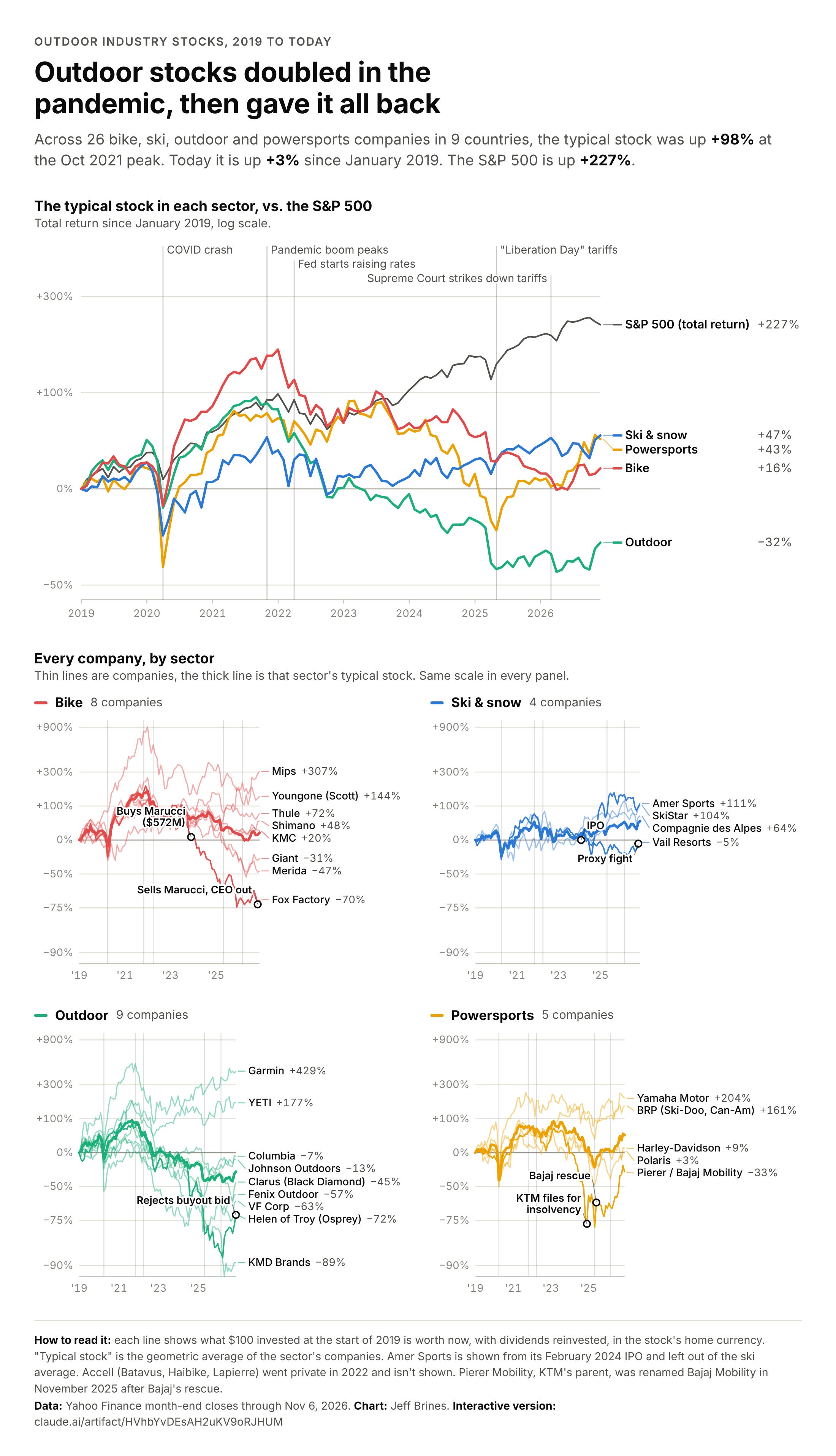
6. Capital is the quiet story under everything. Many of these brands were bought or expanded with cheap pandemic-era debt. Now rates are higher and investors’ attention is on AI, not on outdoor brands with flat demand. Fox sold Marucci at 39 cents on the dollar. Accell went for parts. Bianchi is renegotiating its debt. I expect more of this: more sales at low prices, more consolidation, and more brands ending up with whoever has cash, often Asian capital or private equity. The refund money flattered 2026, and 2027 is when we see who can actually stand on their own.
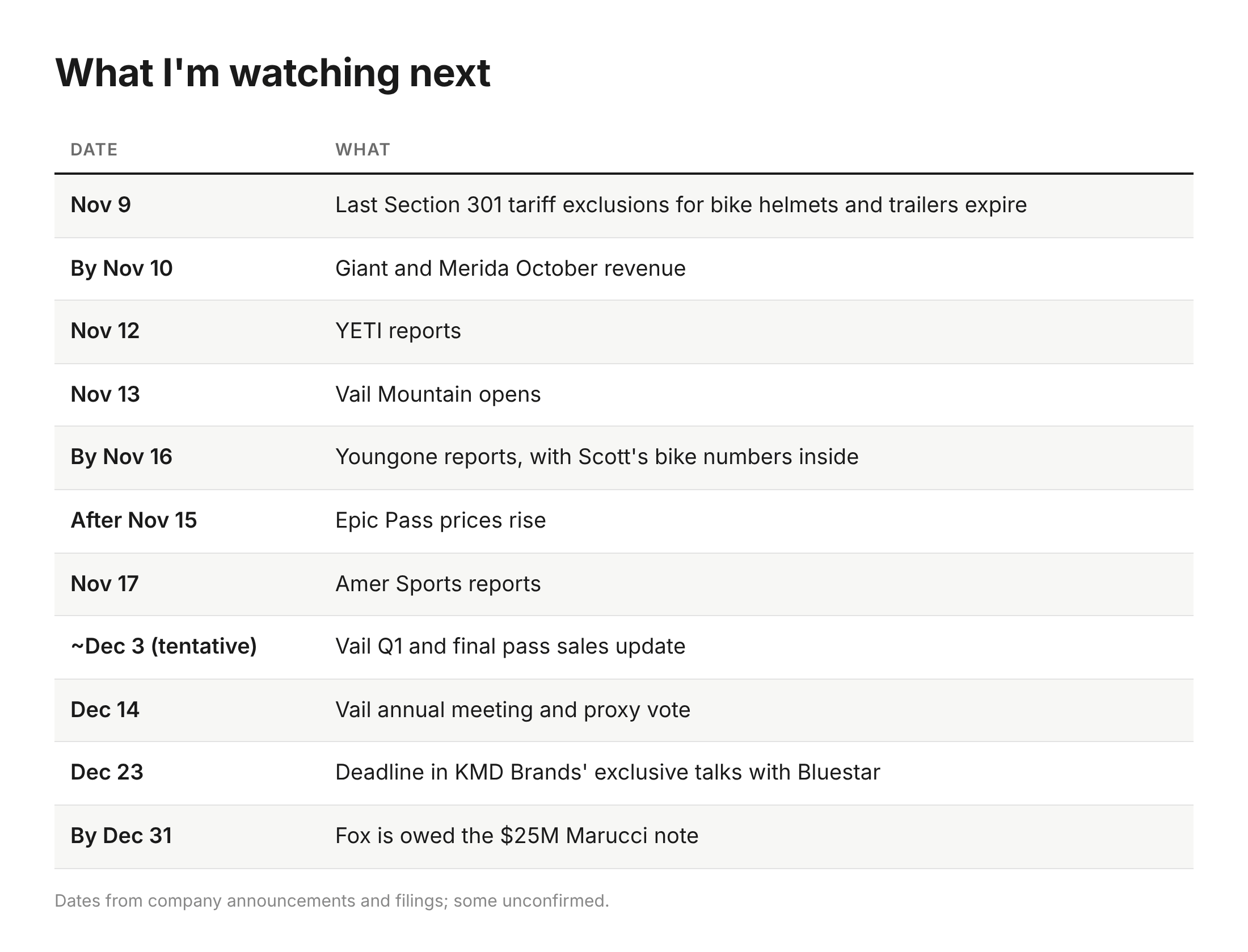
What I’m watching next
Honestly, 90% of my attention right now isn’t on bikes or skis. It’s on AI, and the capital it’s eating.
This buildout is so big that it’s competing with government debt for the same dollars. I’ve never seen a technology do that. It’s bending the debt markets in ways the Fed doesn’t seem able to fully control. Add the political pendulum swinging back to blue, and you have a lot of moving parts in the cost of money.
Here’s why that matters for this newsletter. Much of the outdoor industry was bought or built with cheap debt. Don’t ignore some of the debt needing to get repriced as the term comes due. It could quietly begin to collapse these lower margin, elastic demand style companies. When capital is scarce and expensive, the brands with debt and flat demand get squeezed first, and the buyers get pickier. It may not be bikes or skis, but it’ll shape who owns them.
I track all of this daily on the Outdoor Pulse Newswire. This post is my analysis and opinion, not investment advice. As always, I welcome anyone who wants to reach out. Jeff.brines@gmail.com - and those wonder “what I do”, head over to www.jeffbrines.com for a breakdown!
Disclaimer: All thoughts an opinions my own. Not investment advice. I do use AI as the editor of my posts, and at time for research. Trust me, you don’t want to read my rambling stream of consciousness. AI vastly improves the underlying legibility of my writing. Models used here: Opus 5.5